
Consider the concept hierarchies as shown in the figure. Which of the following options denotes the total number of possible data cuboids from these concept hierarchies? 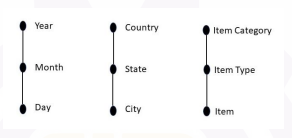
To solve this question, we need to understand the concept of data cuboids and how they are derived from concept hierarchies.
In the given problem, there are three concept hierarchies:
- Year → Month → Day
- Country → State → City
- Item Category → Item Type → Item
Each hierarchy represents a dimension with different levels of granularity or detail.
The number of possible data cuboids can be determined by calculating the product of the number of levels in each hierarchy. In this case, each hierarchy has 4 levels (including the all-inclusive level "ALL"). Therefore, for three hierarchies, the total number of possible cuboids is calculated as:
\(4^3\)
Calculating \(4^3\) gives us:
\(4^3 = 4 \times 4 \times 4 = 64\)
Hence, the correct option is \(4^3\), which denotes the total number of possible data cuboids.
Explanation:
- Each axis in the cube represents one hierarchy and thus can roll up or down along its own levels.
- This results in a large number of possible combinations of dimensions and levels across the hierarchies.
Therefore, the correct answer to the question is \(4^3\), representing a total of 64 possible data cuboids resulting from these concept hierarchies.
Important Questions from Data Warehouse Modelling
Consider a fact table in an OLAP application: Facts(D1, D2, val), where D1 and D2 are its dimension attributes and val is a dependent attribute. Suppose attribute D1 takes 3 values and D2 takes 2 values, and all combinations of these values are present in the table Facts. How many tuples are there in the result of the following query?
SELECT D1, D2, sum(val)
FROM Facts
GROUP BY CUBE (D1, D2);- Consider that the visualization of a 3-dimensional data cube is showing Sales Quantity for each combination of the attributes Product Type, Month and Country.
From this, if we want to further visualize the Sales Quantity for each combination of Product Type, Month and State, which of the following OLAP operations should be performed?


