
Read the following passages and answer the items that follow the passages. Your answers to these items should be based on the passages only. “The history of science is the real history of mankind.” In this striking epigram, a nineteenth-century writer links science with its background. Like most epigrams, its power lies in emphasizing by contrast an aspect of truth which may be easily overlooked. In this case, it is easy to overlook the relations between science and mankind, and to treat the former has some abstract third party, which can sometimes be praised for its beneficial influences, but frequently and conveniently blamed for the horrors of war. Science and mankind cannot be divorced from time to time at men’s convenience. Yet we have seen that, in spite of countless opportunities of improvement, the opening years of the present period of civilization have been dominated by international conflict. Is this the inevitable result of the progress of science or does the fault lie elsewhere?
Based on the above passage, the following assumptions have been made: 1. The horrors of modern life are the inevitable result of the progress of science. 2. The aspect of truth likely to be overlooked is that science is what man has made it. Which of the assumptions given above is/are correct?
2 only
Assumption 1 is invalid: The passage questions whether the international conflicts and horrors of modern life are the inevitable results of scientific progress in the lines, “Is this the inevitable result of the progress of science or does the fault lie elsewhere?”. Here the author contradicts the assertion that the horrors of modern life are the inevitable result of the progress of science, suggesting that the real cause lies elsewhere (for example, the direction in which science has progressed). The author is thus questioning rather than affirming the inevitability.
Assumption 2 is valid: The passage reflects on how science and mankind cannot be divorced at convenience and points out that treating science as an abstract entity separate from human agency is misleading. This supports the assumption that the overlooked truth is that science is indeed shaped by human actions and decisions. It aligns well with the passage’s theme of emphasizing the interconnectedness of science and human agency.
Important Questions from Miscellaneous Topics
- In communication the word 'Haptics' signifies :
- Which of the following statements best defines the scope of semiotics?
The compound interest on Rs. 75,000 for three years, at successive interest rates of 4%, 6% and 9% for each year respectively is:
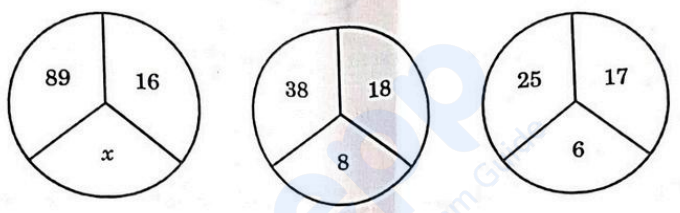
The value of x in the following figures is :
When a child reaches adolescence, there is apt to be a conflict between the parents and the child, since
the latter considers himself to be by now quite capable of managing his own affairs, while the former
are filled with parental solicitude, which is often a disguise for love of power. Parents consider, usually,
that the various moral problems which arise in adolescence are peculiarly their province. The options
they express, however, are so dogmatic that the young seldom confide in them, and usually go their
own way in secret.


