
Read the following passages and answer the items that follow the passages. Your answers to these items should be based on the passages only. By the time children reach class 8, the bulk of them tend to be in the age range of 13 years to 15 years. But in our country, about a quarter of all children in class 8 struggle with reading simple texts and more than half are still unable to do basic arithmetic operations like division. Every year about 25 million young boys and girls from elementary school move into the life that lies for them beyond compulsory schooling. They cannot enter the workforce at least in the organized sector till they are 18. For many families, these children are the first from their families ever to get this far in school. Parents and children expect that such ‘graduates’ from school will go on to high school and college. Hardly anyone wants to go back to agriculture. On the other hand, abilities in terms of academic competencies are far lower than they should be even based on curricular expectations of class 8.
Based on the above passage, the following assumptions have been made : 1. For effective school education, parents have greater role than the governments. 2. School curriculum that conforms to today’s requirements and is uniform for the entire country may address the issues brought out. Which of the assumptions given above is/are valid?
Neither 1 nor 2
Assumption 1 is invalid: The passage does not explicitly discuss the relative roles of parents and the government in school education.It focuses on the educational challenges and expectations faced by children and their families only, as evident in the line “For many families, these children are the first from their families ever to get this far in school. Parents and children expect that such ‘graduates’ from school will go on to high school and college. Hardly anyone wants to go back to agriculture”. There is no clear indication that parents' roles are greater than those of the government in addressing these issues. Hence, this assumption is incorrect.
Assumption 2 is invalid: The passage strictly discusses the lags in basic academic competencies, but does not spell out any reason for the same. Further, it cannot be assumed that a uniform curriculum across the country would address the issue. Therefore, this assumption would go beyond the scope of the passage
Important Questions from Miscellaneous Topics
- In communication the word 'Haptics' signifies :
- Which of the following statements best defines the scope of semiotics?
The compound interest on Rs. 75,000 for three years, at successive interest rates of 4%, 6% and 9% for each year respectively is:
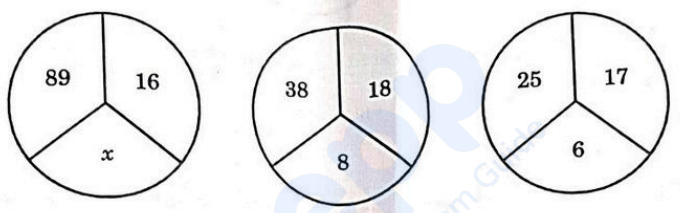
The value of x in the following figures is :
When a child reaches adolescence, there is apt to be a conflict between the parents and the child, since
the latter considers himself to be by now quite capable of managing his own affairs, while the former
are filled with parental solicitude, which is often a disguise for love of power. Parents consider, usually,
that the various moral problems which arise in adolescence are peculiarly their province. The options
they express, however, are so dogmatic that the young seldom confide in them, and usually go their
own way in secret.


