
Assume that an op-amp 741 connected as a unit gain inverting amplifier is applied with an input change of 10 V. Determine the time taken for the output to change by 10 V. [Slew rate for op-amp 741 = 0.5 V/µs]
20 µs
Understanding the Op-Amp Slew Rate Concept
The question asks us to find the time it takes for the output voltage of a 741 operational amplifier (op-amp) to change by a specific amount, given its slew rate. The op-amp is configured as a unity gain inverting amplifier, but this configuration detail doesn't directly affect the slew rate calculation itself, which is an intrinsic property of the op-amp.
Key terms:
- Op-amp 741: A specific type of operational amplifier integrated circuit.
- Unity Gain: The output voltage magnitude equals the input voltage magnitude.
- Inverting Amplifier: An amplifier configuration where the output signal is 180 degrees out of phase with the input signal.
- Slew Rate (SR): This is the maximum rate at which the op-amp's output voltage can change over time. It's typically measured in volts per microsecond (V/µs). It limits how fast the output can respond to input changes, especially for large voltage swings or high frequencies.
- Input Change: The change applied to the input signal ($\Delta V_{in}$ = 10 V).
- Output Change: The corresponding change in the output voltage ($\Delta V_{out}$ = 10 V).
We are given:
- Slew Rate (SR) = 0.5 V/µs
- Output Voltage Change ($\Delta V_{out}$) = 10 V
We need to determine the Time Taken ($\Delta t$) for this output change.
Calculating the Time Taken
The slew rate defines the maximum speed of the output voltage change. The relationship between slew rate, output voltage change, and the time taken for that change is given by the formula:
\(\text{SR} = \frac{\Delta V_{out}}{\Delta t}\)
To find the time taken ($\Delta t$), we can rearrange this formula:
\(\Delta t = \frac{\Delta V_{out}}{\text{SR}}\)
Now, let's substitute the given values into the formula:
- $\Delta V_{out} = 10$ V
- SR = 0.5 V/µs
Plugging these values in:
\(\Delta t = \frac{10 \text{ V}}{0.5 \text{ V/\mu s}}\)
Performing the division:
\(\Delta t = 20 \text{ \mu s}\)
Therefore, the time taken for the output voltage to change by 10 V is 20 microseconds.
Important Questions from Op-Amp and Its Applications
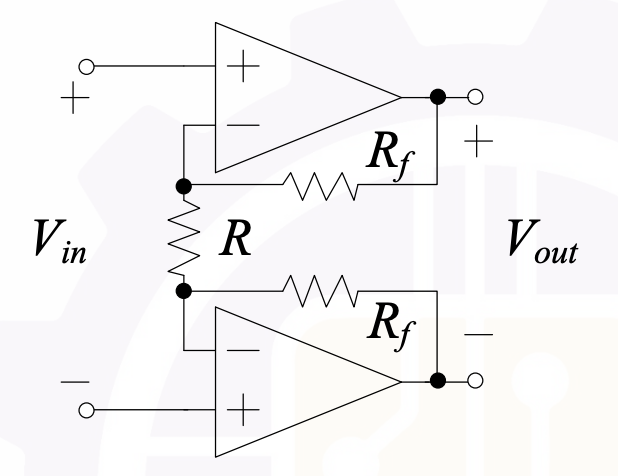
In the circuit shown below, $R$ is $1\text{ k}\Omega$ and $R_f$ is $10\text{ k}\Omega$. If $V_{\text{in}}$ is $100\text{ mV}$ and the op-amps have supply voltages of $\pm 15\text{ V}$, then $V_{\text{out}}$ is _______ V.
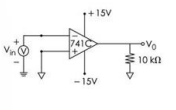
For IC 741 circuit shown below, the maximum input frequency above which the output will be distorted is ____________.
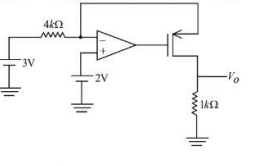
What is the value of output voltage $V_o$ in the given circuit? Assume op-amp to be ideal and MOSFET operating in saturation region.
In an ideal op-amp, the common mode gain is _____________.
Assertion (A) : An Op-Amp is a direct coupled high gain amplifier.
Reason (R) : It consists of one or more differential amplifiers and usually followed by a level translator and push pull stage.


