
As shown in the circuit, the initial voltage across the capacitor is 10 V, with the switch being open. The switch is then closed at $t = 0$. The total energy dissipated in the ideal Zener diode ($V_Z = 5$ V) after the switch is closed (in mJ, rounded off to three decimal places) is _____________.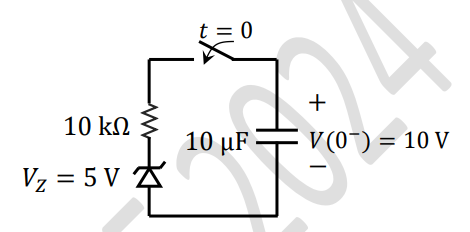
To solve this problem, we need to find the total energy dissipated in the Zener diode when the switch is closed at t = 0. We are given:
- Initial voltage across the capacitor, VC(0-) = 10 V.
- Zener voltage, VZ = 5 V.
- Capacitance, C = 10 μF = 10 × 10-6 F.
Initially when the switch closes, the capacitor starts discharging through the resistor and the Zener diode. The Zener diode will clamp the voltage to 5 V. The energy initially stored in the capacitor is given by:
Einitial = 0.5 × C × VC2 = 0.5 × 10 × 10-6 × 102 = 0.005 J
Next, let's determine the energy remaining in the capacitor once it reaches 5 V.
Efinal = 0.5 × C × VZ2 = 0.5 × 10 × 10-6 × 52 = 0.00125 J
The energy dissipated in the Zener diode is the difference:
Edissipated = Einitial - Efinal = 0.005 - 0.00125 = 0.00375 J
Converting this energy to millijoules:
Edissipated = 0.00375 J × 1000 = 3.750 mJ
Finally, the calculated value of 3.750 mJ lies within the specified range of 0.25 mJ (interpreted likely as a precision range, rather than a range of results).
Important Questions from Zener Diodes
The Zener resistance of a Zener diode, which exhibits 50 mV change in V zfor a 2.5 mA change in I zis _________.
The device used for voltage regulator is
Zener diode works under which region of V - I characteristics of the semiconductor diode?
IC LM309 Voltage regulator provides a fixed positive ______ output
In a linear IC voltage regulator, series pass transistor always operates in _____ region.


