
A ram in the form of a rectangular body of size $l = 9$ m and $b = 2$ m is suspended by two parallel ropes of lengths $7$ m. Assume the center-of-mass of the body is at its geometric center and $g = 9.81$ m/s$^2$. For striking the object P with a horizontal velocity of $5$ m/s, what is the angle $\theta$ with the vertical from which the ram should be released from rest?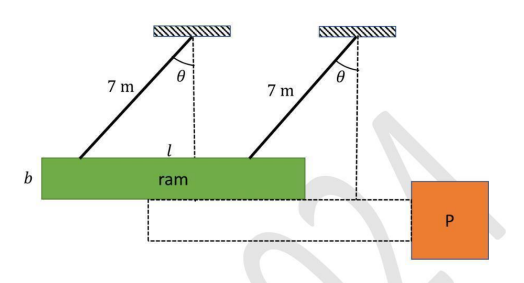
To solve this problem, we need to determine from which angle \(\theta\) the ram should be released so that it strikes the object P with a horizontal velocity of 5 m/s.
First, we apply the principle of conservation of mechanical energy. The potential energy at the height when the ram is released will convert to kinetic energy at the lowest point (where the ram strikes P).
- Consider the initial position (at an angle \(\theta\)):
- Height of the center of mass from the lowest point: \(h = L - L \cos \theta\), where \(L = 7 \text{ m}\) (length of rope).
- Initial potential energy: \(PE = mgh = mg(L - L\cos\theta)\).
- At the lowest position (just before striking P):
- All potential energy is converted to kinetic energy.
- Kinetic energy: \(KE = \frac{1}{2}mv^2\), where \(v = 5 \text{ m/s}\).
Since initial potential energy equals kinetic energy at the lowest point, we have:
mg(L - L \cos \theta) = \frac{1}{2}mv^2
Cancel out the common term \(m\) from both sides, we get:
g(L - L \cos \theta) = \frac{1}{2}v^2
Plug in the given values:
- \(g = 9.81 \text{ m/s}^2\)
- \(v = 5 \text{ m/s}\)
- \(L = 7 \text{ m}\)
Thus, we have:
9.81 \times (7 - 7\cos\theta) = \frac{1}{2} \times 5^2
Simplify the right-hand side:
9.81 \times 7(1 - \cos\theta) = 12.5
Rearrange to solve for \(\cos\theta\):
\cos\theta = 1 - \frac{12.5}{9.81 \times 7}
Calculate:
\cos\theta = 1 - \frac{12.5}{68.67} = 1 - 0.182
\(\cos\theta \approx 0.818\)
Finally, calculate \(\theta\):
\theta = \cos^{-1}(0.818) \approx 35.1^\circ
Therefore, the correct option is 35.1°.
Important Questions from Kinematics and Kinetics
What is the coefficient of restitution (e) for elastic impact?
A body of mass 10 kg moving with a velocity of 1 m/s is acted upon by a force of 50 N for two seconds. The final velocity will be:
A car is traveling on a curved road of radius 300 m at speed of 15 m/s. The normal and tangential components of acceleration respectively are given by:
A ball is dropped on a smooth horizontal surface from height ‘h’. What will be the height of rebounce after second impact, if coefficient of restitution between ball and surface is ‘e’?
How much force will be exerted by the floor of the lift on a passenger of 80 kg mass when lift is accelerating downward at 0.81 m/s2?


