
Question
A pedigree of an inheritable disease is shown below. 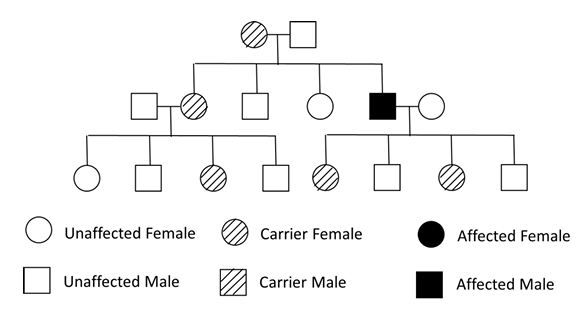
The correct answer is
X-linked recessive
The pedigree described in the question is designed to determine the pattern of inheritance for a specific disease. Let's analyze the pedigree step-by-step:
- In the pedigree chart, males are represented by squares, and females by circles. Affected individuals are filled, and unaffected are open. Carrier states, if represented, are often shown with half-filled shapes.
- In X-linked recessive inheritance:
- Males (with only one X chromosome) will express the disease if they inherit the affected X chromosome.
- Females (with two X chromosomes) must inherit two affected X chromosomes to express the disease; if they inherit only one, they become carriers.
- Affected males pass the affected X chromosome to all their daughters (making them carriers if the mother is unaffected) and none to their sons.
- Check the generations in the pedigree chart:
- First Generation: One male is affected which suggests that the disease might be X-linked since he could have inherited the X chromosome from a carrier mother.
- Second Generation: An affected male from an unaffected father points to an X-linked pattern, as he must have received the affected X from his carrier mother.
- The pattern where no affected sons come from an affected father supports the X-linked recessive inheritance mode.
- Verify against the options:
- Autosomal dominant: Not possible, as not all generations show affected offspring from affected parents.
- X-linked dominant: Unlikely, as affected fathers would pass the disease to all daughters.
- X-linked recessive: Fits the observed pattern where mainly males are affected, and females are carriers.
- Autosomal recessive: Unlikely given the skewed gender distribution of affected individuals.
Thus, the correct answer is X-linked recessive.
Was this answer helpful?
Important Questions from Mendelian Inheritance
- Mendel's 'law of segregation' applies to the segregation of __________ during gamete formation.
- Fabry disease in humans is a X-linked disease. The probability (in percentage) for a phenotypically normal father and a carrier mother to have a son with Fabry disease is ________.
The allele associated with albinism in humans is recessive ($c$). The probability that an albino male ($cc$) and a carrier female ($Cc$) will have an offspring with normal skin pigmentation is _________.
(Round off to one decimal place)
- The blood group of the mother is A⁺ and that of the father is AB⁺. Which of the following statements is/are correct?
- Assuming independent assortment and no recombination, the number of different combinations of maternal and paternal chromosomes in gametes of an organism with a diploid number of 12 is ________.
Need Expert Advice?


