
A particle of mass $m$ is moving in the potential
$V(x) = \begin{cases} V_0 + \frac{1}{2}m\omega_0^2x^2, & x > 0, \\ \infty, & x \le 0, \end{cases}$
Figures P, Q, R and S show different combinations of the values of $\omega_0$ and $V_0$. 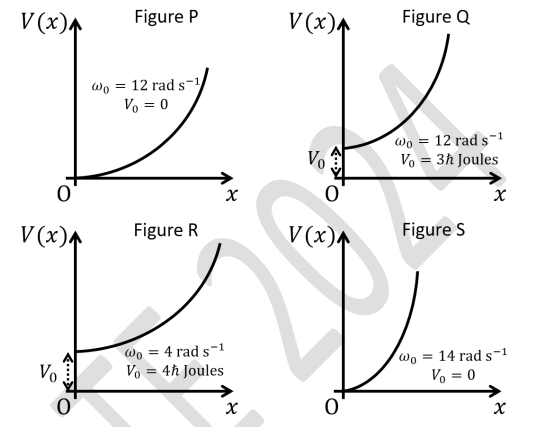
$E_j^{(P)}, E_j^{(Q)}, E_j^{(R)}$ and $E_j^{(S)}$ with $j = 0, 1, 2, ...$, are the eigen-energies of the $j$-th level for the potentials shown in figures P, Q, R and S, respectively. Which of the statement is/are true?
To determine the true statements for this potential, follow these steps:
1. Identify the eigen-energy formula:
The potential is a vertically shifted half-harmonic oscillator. Due to the infinite wall at $x=0$, only the odd-parity states of a full oscillator are allowed. The formula for the $j$-th level energy is:
$E_j = V_0 + (2j + \frac{3}{2})\hbar\omega_0$
2. Calculate relevant energy levels:
- Figure P: $E_0^{(P)} = 0 + 1.5(12)\hbar = 18\hbar$
- Figure Q: $E_0^{(Q)} = 3\hbar + 1.5(12)\hbar = 21\hbar$
- Figure R: $E_0^{(R)} = 4\hbar + 1.5(4)\hbar = 10\hbar$ and $E_1^{(R)} = 4\hbar + 3.5(4)\hbar = 18\hbar$
- Figure S: $E_0^{(S)} = 0 + 1.5(14)\hbar = 21\hbar$
3. Evaluate the options:
- Option 1: $E_0^{(P)} = E_0^{(Q)} \implies 18\hbar = 21\hbar$ (False)
- Option 2: $E_0^{(Q)} = E_0^{(S)} \implies 21\hbar = 21\hbar$ (True)
- Option 3: $E_0^{(P)} = E_1^{(R)} \implies 18\hbar = 18\hbar$ (True)
- Option 4: $E_0^{(R)} \neq E_0^{(Q)} \implies 10\hbar \neq 21\hbar$ (True)
The true statements are Option 2, Option 3, and Option 4.
Important Questions from Schrödinger Equation 1D Potentials Harmonic Oscillator
The wavefunction of a particle in an infinite one-dimensional potential well at time $t$ is
$\Psi(x, t) = \sqrt{\frac{2}{3}} e^{-iE_1t/\hbar}\psi_1(x) + \frac{1}{\sqrt{6}} e^{i\pi/6}e^{-iE_2t/\hbar}\psi_2(x) + \frac{1}{\sqrt{6}} e^{i\pi/4}e^{-iE_3t/\hbar}\psi_3(x)$
where $\psi_1, \psi_2$ and $\psi_3$ are the normalized ground state, the normalized first excited state and the normalized second excited state, respectively. $E_1, E_2$ and $E_3$ are the eigen-energies corresponding to $\psi_1, \psi_2$ and $\psi_3$, respectively. The expectation value of energy of the particle in state $\Psi(x, t)$ isA particle is subjected to a potential
$V(x) = \begin{cases} \infty, & x \le 0 \\ V_0, & a \le x \le b \\ 0, & \text{elsewhere} \end{cases}$
Here, $a > 0$ and $b > a$. If the energy of the particle $E < V_0$, which one of the following schematics is a valid quantum mechanical wavefunction ($\Psi$) for the system?- The wavefunction for a particle is given by the form $e^{-(iax+\beta)}$, where $a$ and $\beta$ are real constants. In which one of the following potentials $V(x)$, the particle is moving?
- Young's double slit experiment is performed using a beam of $C_{60}$ (fullerene) molecules, each molecule being made up of 60 carbon atoms. When the slit separation is 50 nm, fringes are formed on a screen kept at a distance of 1 m from the slits. Now, the experiment is repeated with $C_{70}$ molecules with a slit separation of 92.5 nm. The kinetic energies of both the beams are the same. The position of the 4th bright fringe for $C_{60}$ will correspond to the $n^{th}$ bright fringe for $C_{70}$. What is the value of $n$ (rounded off to the nearest integer) ?
- Consider a particle in a two dimensional infinite square well potential of side $L$, with $0 \le x \le L$ and $0 \le y \le L$. The wavefunction of the particle is zero only along the line $y = \frac{L}{2}$, apart from the boundaries of the well. If the energy of the particle in this state is $E$, what is the energy of the ground state?


