
A forester, pictured below, is trying to measure the height of a tree. Her height is $x = 1.5$ m. She stands $y = 10$ m away from a tree, from where the angle subtended to the top of the tree is $z = 45^ \circ$. The height of the tree is ______ m (round off to 1 decimal place). 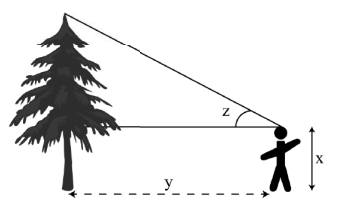
To determine the height of the tree, we will use trigonometry. The forester observes the tree from a distance of \( y = 10 \) m, with an angle \( z = 45^\circ \) to the top of the tree.
The tangent of an angle in a right triangle is the ratio of the opposite side to the adjacent side:
\[\tan(z) = \frac{\text{opposite}}{\text{adjacent}}\]
Here, the opposite side is the difference in height between the tree and the forester, and the adjacent side is the distance from the forester to the base of the tree.
Therefore, we can write:
\[\tan(45^\circ) = \frac{h - x}{y}\]
Given \( \tan(45^\circ) = 1 \), \( x = 1.5 \) m, and \( y = 10 \) m, we substitute the known values:
\[1 = \frac{h - 1.5}{10}\]
Solving for \( h \):
\[h - 1.5 = 10\]
\[h = 10 + 1.5\]
\[h = 11.5\]
The height of the tree is 11.5 m.
Verifying against the given range (11.49, 11.51): The calculated height \( 11.5 \) m falls within this range, confirming the solution's accuracy.
Important Questions from Calculus
The ratio of volume to surface area of solid semi sphere is related to its radius through
The value of \(\int^2_0\int^x_0y\ dy\ dx\)
Find the slope of normal to the curve y = x2 + 7x at (1, 8).
Find the equation of normal to the curve y = 4x - 3x2 at (2, -4).
- \(\mathop {\lim }\limits_{\theta \to \frac{\pi }{2}} \frac{{\log \left( {\theta - \frac{\pi }{2}} \right)}}{{\tan \theta }}\)


