
A dentist has a small mirror of focal length 1.6 cm. He observes the cavity in the tooth of a patient by holding the mirror at a distance of 8 mm from the cavity. The magnification is:
2
The mirror formula is:
\[ \frac{1}{f} = \frac{1}{v} - \frac{1}{u} \]
Given focal length \( f = 1.6 \) cm and object distance \( u = -0.8 \) cm:
\[ \frac{1}{v} = \frac{1}{1.6} + \frac{1}{0.8} = \frac{1}{1.6} + \frac{2}{1.6} = \frac{3}{1.6} \]
\[ v = \frac{1.6}{3} = -2.4 \text{ cm} \]
Magnification \( m = -\frac{v}{u} = -\frac{-2.4}{0.8} = 2 \).
Thus, the correct answer is option 3.
Important Questions from Ray Optics and Optical Instruments
A Convex mirror produces the magnification 1/3 and 1/4 when the object is placed at the points P and Q in front of the mirror.
Which of the following statements are correct?
- A. The saturation current is constant with collector plate potential for different frequencies of incident radiation.
- B. The saturation current is different with collector plate potential for different frequencies of incident radiation.
- C. The saturation current is different with collector plate potential for different intensity of incident radiation.
- D. The saturation current is constant with collector plate potential for different intensity of incident radiation.
- E. Below threshold frequency, no photoelectrons are emitted.
Choose the correct answer from the options given below:
For insulators and semiconductors, the resistance decreases with an increase in temperature because:
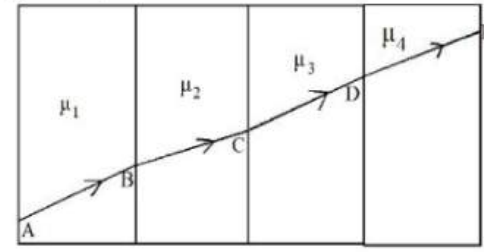
A ray of light passes through four transparent media with refractive index μ1, μ2, μ3, and μ4 as shown in the figure. The surfaces of all media are parallel. If BC and DE are parallel, we must have:
Light of uniform intensity shines perpendicularly on a totally absorbing surface, fully illuminating the surface. If the area of the surface is decreased, what is the effect on radiation pressure?


