A circuit has three branches with resistors: 2 ohms, 4 ohms, and 8 ohms in parallel. Which statement correctly describes the current through the 2 ohm resistor compared to the 8 ohm resistor?
The current through the 2 ohm resistor is greater than that through the 8 ohm resistor
In a parallel circuit, every branch has the same voltage V across it.
By Ohm’s law, the branch current is \(I = \frac{V}{R}\), so current is inversely proportional to resistance.
\(I_2 = \frac{V}{2}\) and \(I_8 = \frac{V}{8}\), so \(\frac{I_2}{I_8} = 4\) — the 2 Ω branch carries four times the current of the 8 Ω branch.
The other statements fail: no branch current is zero because each resistor has the full voltage across it; currents are equal only when resistances are equal; and a smaller resistance carries more current, not less.
Hence, the answer is The current through the 2 ohm resistor is greater than that through the 8 ohm resistor.
Similar Questions
Which effect would you observe if one branch in a parallel resistor circuit is disconnected?
Which of the following statements is correct, if three resistors of equal value are connected in parallel across a constant voltage source?
Two resistors of 3 Ω and X Ω are connected in parallel such that the effective resistance is 2 Ω. What is the value of X (in Ω)?
Two resistors with resistance of 2 Ω and 8 Ω are connected in parallel. What is the equivalent resistance (Req) of the combination?
Important Questions from Series and Parallel Connection of Resistance
How much resistance must be connected in parallel with a 360 Ω resistor to obtain an equivalent resistance Req of 120 Ω?
If n identical resistance, each of resistance R, are connected in parallel, the equivalent resistance is:
Three resisters of 3 ohm, 10 ohm and 15 ohm are connected in parallel in a 30 V circuit. The current will that flow through the 3-ohm resistor is:
- In which combination, the electrical appliances are connected at home?
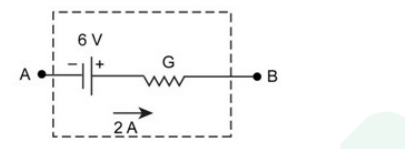
For the figure shown below, find the value of conductance 'G' (in S).