
A circle of radius $1$ unit is divided into four quarters and rejoined as shown below.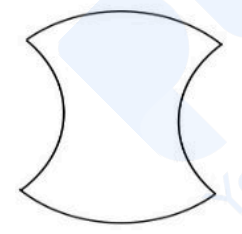
What is the area of this shape?
2
To solve this problem, let's first understand the composition of the shape given in the image.
The circle has a radius of \(1\) unit and is divided into four quarters. Each quarter of the circle is a quarter-circle with radius \(1\).
The original area of the full circle is given by the formula:
\(A = \pi r^2\)
where \(r = 1\) unit.
Therefore, the area of the full circle:
\(A = \pi \times 1^2 = \pi\)
Each quarter-circle has an area of:
\(\text{Area of one quarter} = \frac{\pi}{4}\)
When the four quarters are rearranged back together, they form the shape shown in the image. The outer parts of the quarters form a complete circle, whereas the inner parts create two concave segments (one on each side). These concave segments are not part of the area calculation since they essentially "cancel out" each other's contribution.
The shape essentially consists of two semicircles with radii of \(1\) unit, positioned opposite each other, forming an oval shape with the same overall area as the original circle.
Therefore, the area of this rearranged shape remains the same as the original circle, which accounts for the full circle's circumference being redistributed rather than altered:
\(\text{Area of the shape} = 2\)
The correct answer is therefore 2.
```
Important Questions from Mensuration 2D (Notes)
- $P_1$ and $P_2$ are two regular polygons. The sum of all the interior angles of $P_1$ is $1800^\circ$. Each interior angle of $P_2$ exceeds its exterior angle by $120^\circ$. The difference between the number of sides of $P_1$ and $P_2$ is:
- The perimeter of the triangle is 24 cm and if the sides of the triangles are by prime numbers then the half of the area of triangle (in $cm^2$) is:
- The area of a square is 324 cm$^2$. Its perimeter is equal to the perimeter of a regular hexagon. What is the area (in cm$^2$) of the hexagon?
- If the area of a rhombus is $10 \text{ cm}^2$ and one of its interior angles is $150^\circ$, what is the perimeter (in cm) of the rhombus?
- If the area of a rhombus is 10 cm$^2$ and one of its interior angles is 150°, what is the perimeter (in cm) of the rhombus?


