(Take $\pi = 3.14$)
Data Summary
- Wire diameter, \(d_w = 2 \text{ mm} = 0.002 \text{ m}\)
- Wire radius, \(r_w = d_w / 2 = 0.001 \text{ m}\)
- Insulation thickness, \(t_{ins} = 2 \text{ mm} = 0.002 \text{ m}\)
- Outer radius of insulation, \(r_o = r_w + t_{ins} = 0.001 \text{ m} + 0.002 \text{ m} = 0.003 \text{ m}\)
- Thermal conductivity of plastic, \(k = 0.5 \text{ W.m}^{-1}\text{.K}^{-1}\)
- Ambient air temperature, \(T_\infty = 320 \text{ K}\)
- Convective heat transfer coefficient, \(h = 25 \text{ W.m}^{-2}\text{.K}^{-1}\)
- Wire surface temperature, \(T_w = 420 \text{ K}\)
- Temperature difference, \(\Delta T = T_w - T_\infty = 420 \text{ K} - 320 \text{ K} = 100 \text{ K}\)
- Value of \(\pi \approx 3.14\)
Wire Heat Loss Without Insulation
For a bare wire, heat transfer occurs solely through convection from the wire surface to the surrounding air. The heat loss per meter length is calculated using Newton's Law of Cooling.
The surface area of the wire per meter length is calculated as:
\( \frac{A_w}{L} = 2 \pi r_w = 2 \times 3.14 \times 0.001 \text{ m} = 0.00628 \text{ m} \)
The heat loss per meter length without insulation ($Q_{no\_ins}/L$) is:
\( \frac{Q_{no\_ins}}{L} = h \times \frac{A_w}{L} \times \Delta T \)
\( \frac{Q_{no\_ins}}{L} = 25 \text{ W.m}^{-2}\text{.K}^{-1} \times 0.00628 \text{ m} \times 100 \text{ K} \)
\( \frac{Q_{no\_ins}}{L} = 15.7 \text{ W/m} \)
Insulated Wire Heat Loss Calculation
When the wire is insulated, heat transfer involves both conduction through the plastic insulation and convection from the outer surface of the insulation to the air. The total thermal resistance per meter length is the sum of these two resistances.
1. Conduction Resistance per meter length:
The resistance to heat conduction through the cylindrical insulation is:
\( R_{cond}/L = \frac{\ln(r_o/r_w)}{2 \pi k} \)
\( R_{cond}/L = \frac{\ln(0.003 \text{ m} / 0.001 \text{ m})}{2 \times 3.14 \times 0.5 \text{ W.m}^{-1}\text{.K}^{-1}} = \frac{\ln(3)}{3.14} \approx \frac{1.0986}{3.14} \approx 0.3492 \text{ K.m/W} \)
2. Convection Resistance per meter length:
The outer surface area of the insulation per meter length is:
\( \frac{A_o}{L} = 2 \pi r_o = 2 \times 3.14 \times 0.003 \text{ m} = 0.01884 \text{ m} \)
The resistance to heat convection from the outer surface is:
\( R_{conv}/L = \frac{1}{h \times (A_o/L)} \)
\( R_{conv}/L = \frac{1}{25 \text{ W.m}^{-2}\text{.K}^{-1} \times 0.01884 \text{ m}} = \frac{1}{0.471} \approx 2.123 \text{ K.m/W} \)
3. Total Resistance and Heat Loss:
The total thermal resistance per meter length is the sum of conduction and convection resistances:
\( R_{total}/L = R_{cond}/L + R_{conv}/L \approx 0.3492 \text{ K.m/W} + 2.123 \text{ K.m/W} = 2.4722 \text{ K.m/W} \)
The heat loss per meter length with insulation ($Q_{ins}/L$) is:
\( \frac{Q_{ins}}{L} = \frac{\Delta T}{R_{total}/L} \)
\( \frac{Q_{ins}}{L} = \frac{100 \text{ K}}{2.4722 \text{ K.m/W}} \approx 40.45 \text{ W/m} \)
Ratio of Heat Losses Determination
The ratio of heat loss with insulation to heat loss without insulation is calculated by dividing the heat loss per meter length in both cases.
Ratio = \( \frac{Q_{ins}/L}{Q_{no\_ins}/L} \)
Ratio = \( \frac{40.45 \text{ W/m}}{15.7 \text{ W/m}} \approx 2.576 \)
Final Result
The ratio of heat loss per meter of wire length with insulation to that without insulation is approximately 2.58.
Important Questions from Steady State Heat Transfer
One side of a solid food block of 10 cm thickness is subjected to a heating medium having a film heat transfer coefficient of $70\ W\cdot(m^2\cdot^\circ C)^{-1}$. The other side of the food block is being cooled by a medium having a film heat transfer coefficient of $100\ W\cdot(m^2\cdot^\circ C)^{-1}$. The food block is having a thermal conductivity of $0.2\ W\cdot(m\cdot^\circ C)^{-1}$ and the contact area of the block available for heat transfer is $1\ m^2$. Heat transfer rate in the block at steady state is $100\ J\cdot s^{-1}$. The temperature difference between the two sides of the block in $^\circ C$ is______________.
[round off to 2 decimal places]- A 2.5 m long pipe is insulated at both ends. It has ID and OD as 50 mm and 56 mm, respectively. Its log-mean heat transfer area in $m^2$ is ________
Select the most appropriate option about boiling and condensation processes as expressed by the statements P, Q and R.
P - The quantities of heat involved in evaporation and condensation of unit mass of fluid are identical
Q - The boiling and condensation of a single compound normally occur isothermally
R - The condensation is achieved at or below dew point and boiling occurs at triple point
- A constant heat flux of 500 W $m^{-2}$ is supplied to one face of a food material having a plate like structure with a thickness of 10 mm. The thermal conductivity of the food material is 1.5 W $m^{-1}$ °$C^{-1}$. From the other face of the food material, heat is dissipated by convection into a fluid of 40 °C temperature. The heat transfer coefficient of the fluid is 100 W $m^{-2}$ °$C^{-1}$. The temperature in °C of the surface to which the heat flux is supplied will be
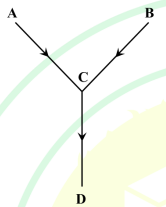
Three straight metal wires, AC, BC and CD, having same length, diameter and thermal conductivity are connected as shown in the figure. Heat flows from points 'A' and 'B' to point ‘C' and from point ‘C' to ‘D'. Temperatures at points A, B and D are 100 °C, 100 °C and 40 °C, respectively. Assuming steady-state condition and no heat loss from the wires, the temperature at point 'C' is _________ °C. (Answer in integer)