Problem: Calculate the log-mean heat transfer area for a pipe with given dimensions and length.
Log-Mean Area Formula
For heat transfer through a cylindrical surface, the log-mean heat transfer area ($A_{lm}$) is used. The formula derived from the geometry is:
$ A_{lm} = \frac{\pi L (D_2 - D_1)}{\ln(D_2 / D_1)} $
Where:
- $L$ is the length of the pipe.
- $D_1$ is the inner diameter.
- $D_2$ is the outer diameter.
Pipe Dimensions
The provided dimensions are:
- Length, $L = 2.5$ m
- Inner Diameter, $ID = D_1 = 50$ mm $= 0.050$ m
- Outer Diameter, $OD = D_2 = 56$ mm $= 0.056$ m
Area Calculation Steps
- Substitute values into the formula:
$ A_{lm} = \frac{\pi \times 2.5 \text{ m} \times (0.056 \text{ m} - 0.050 \text{ m})}{\ln(0.056 \text{ m} / 0.050 \text{ m})} $
- Simplify the expression:
$ A_{lm} = \frac{\pi \times 2.5 \times 0.006}{\ln(1.12)} $
$ A_{lm} = \frac{0.015 \pi}{\ln(1.12)} $
- Calculate the numerical value:
Using $\pi \approx 3.14159$ and $\ln(1.12) \approx 0.11333$: $ A_{lm} \approx \frac{0.015 \times 3.14159}{0.11333} $ $ A_{lm} \approx \frac{0.04712385}{0.11333} $ $ A_{lm} \approx 0.4158 \text{ m}^2 $
Final Result
The calculated log-mean heat transfer area is approximately 0.4158 $m^2$. This value falls within the expected range of 0.41 to 0.42 $m^2$.
Important Questions from Steady State Heat Transfer
- A $2\text{ mm}$ diameter electric wire is insulated with $2\text{ mm}$ thick plastic. The plastic has a thermal conductivity of $0.5\text{ W.m}^{-1}\text{.K}^{-1}$. The wire is exposed to air at $320\text{ K}$ and outside convective heat transfer coefficient is $25\text{ W.m}^{-2}\text{.K}^{-1}$. Wire surface temperature is constant at $420\text{ K}$ and remains unaffected by the covering. Assuming steady state heat transfer conditions, the ratio of heat loss per metre of wire length with insulation to that without insulation is nearest to
(Take $\pi = 3.14$) One side of a solid food block of 10 cm thickness is subjected to a heating medium having a film heat transfer coefficient of $70\ W\cdot(m^2\cdot^\circ C)^{-1}$. The other side of the food block is being cooled by a medium having a film heat transfer coefficient of $100\ W\cdot(m^2\cdot^\circ C)^{-1}$. The food block is having a thermal conductivity of $0.2\ W\cdot(m\cdot^\circ C)^{-1}$ and the contact area of the block available for heat transfer is $1\ m^2$. Heat transfer rate in the block at steady state is $100\ J\cdot s^{-1}$. The temperature difference between the two sides of the block in $^\circ C$ is______________.
[round off to 2 decimal places]Select the most appropriate option about boiling and condensation processes as expressed by the statements P, Q and R.
P - The quantities of heat involved in evaporation and condensation of unit mass of fluid are identical
Q - The boiling and condensation of a single compound normally occur isothermally
R - The condensation is achieved at or below dew point and boiling occurs at triple point
- A constant heat flux of 500 W $m^{-2}$ is supplied to one face of a food material having a plate like structure with a thickness of 10 mm. The thermal conductivity of the food material is 1.5 W $m^{-1}$ °$C^{-1}$. From the other face of the food material, heat is dissipated by convection into a fluid of 40 °C temperature. The heat transfer coefficient of the fluid is 100 W $m^{-2}$ °$C^{-1}$. The temperature in °C of the surface to which the heat flux is supplied will be
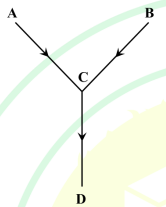
Three straight metal wires, AC, BC and CD, having same length, diameter and thermal conductivity are connected as shown in the figure. Heat flows from points 'A' and 'B' to point ‘C' and from point ‘C' to ‘D'. Temperatures at points A, B and D are 100 °C, 100 °C and 40 °C, respectively. Assuming steady-state condition and no heat loss from the wires, the temperature at point 'C' is _________ °C. (Answer in integer)