
X is a random variable with a uniform probability density function in the interval [-2, 10]. For Y = 2X – 6, the conditional probability P(Y ≤ 7 | X ≥ 5) (rounded off to three decimal places) is
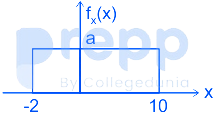
The area under the curve must be 1, i.e.
(10 + 2) × a = 1
\(a=\frac{1}{12}\)
\({{f}_{x}}\left( x \right)=\left\{ \begin{matrix} \frac{1}{12}~~~-2\le x\le 10 \\ 0~~~~otherwise \\ \end{matrix} \right\}\)
Now, y = 2x – 6
∴ fy(y) can be defined as:
\({{f}_{y}}\left( y \right)=\left\{ \begin{matrix} ~~~\frac{1}{24}~~~-10\le x\le 14 \\ 0~~~~~~~~otherwise \\ \end{matrix} \right.\)
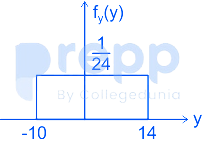
If x ≥ 5, then y ≥ 4
So, P(y ≤ 7|x ≥ 5) = P(y ≤ 7|y ≥ 4)
\(P\left( y\le 7\text{ }\!\!|\!\!\text{ }x\ge 5 \right)=\frac{P\left( 4\le y\le 7 \right)}{P\left( 4\le y\le 14 \right)}\)
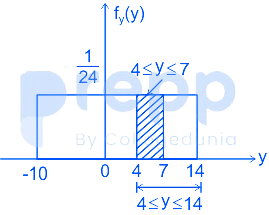
\(P\left( y\le 7\text{ }\!\!|\!\!\text{ }x\ge 5 \right)=\frac{P\left( 4\le y\le 7 \right)}{P\left( 4\le y\le 14 \right)}\)
\(=\frac{3/24}{10/24} \)
= \(\frac{3}{10}\)
=0.3
Important Questions from Random Variables Basics
The length of time X, needed by an examinee of competition to complete a 1-hour exam, is a random variable with
PDF \(f(x)=\dfrac{6}{5}(x^2+x);0 \le x \le 1.\) , The value of F(0.5) is:If X follows a binomial distribution with n = 6 and \(p=\dfrac{1}{4}\) then the skewness of X is:
If the customers arrive in a shop in Poisson fashion with parameter λ, the fourth raw moment \(\mu_4^{'}\) for the inter-arrival time is:
A discrete random variable X has the probability functions as:
X
0
1
2
3
4
5
6
7
8
f(x)
K
2k
3k
5k
5k
4k
3k
2k
k
The value of E(X) is:What percentage of scores falls within three standard deviations from the mean for the normal variate?


