
Why is an indifference curve convex to the origin? (A) Indifference curve slope downward to the right (B) Two commodities are imperfect substitutes (C) Declining marginal rate of substitution between commodities (D) Diminishing marginal utilities Choose the most appropriate answer from the options given below:
B and C only
Understanding Indifference Curves and Convexity
An indifference curve represents all combinations of two goods that provide the same level of satisfaction or utility to a consumer. This means the consumer is indifferent between any point on the same curve. The shape of an indifference curve tells us a lot about how a consumer views the relationship between the two goods.
Why are Indifference Curves Convex to the Origin?
An indifference curve is typically convex to the origin (bowed inwards towards the point (0,0)). This convexity is a key property that reflects fundamental aspects of consumer preferences and the nature of goods.
Let's analyze the given statements to understand which ones explain this convexity:
- (A) Indifference curve slope downward to the right: While it is true that typical indifference curves slope downwards from left to right, this property indicates that if a consumer gives up some amount of one good, they must receive some amount of the other good to maintain the same level of satisfaction. This downward slope signifies that both goods are desirable (have positive marginal utility). However, the downward slope itself does not explain the *curvature* (convexity). It explains the trade-off, not why the trade-off changes along the curve in a specific way.
- (B) Two commodities are imperfect substitutes: If two goods are imperfect substitutes, it means they can be substituted for each other, but not at a constant rate without affecting satisfaction. As a consumer consumes more of one good and less of the other while staying on the same indifference curve, the willingness to give up more of the abundant good for less of the scarce good changes. If goods were perfect substitutes, the indifference curve would be a straight line (constant trade-off, no convexity). If they were perfect complements, the curve would be L-shaped. Imperfect substitutability leads to the changing trade-off observed in a convex curve.
- (C) Declining marginal rate of substitution between commodities: The Marginal Rate of Substitution (MRS) is the rate at which a consumer is willing to give up one good (say, Good Y) to get one more unit of another good (Good X), while remaining on the same indifference curve. Mathematically, it is the absolute value of the slope of the indifference curve at any point. As a consumer moves down an indifference curve (consuming more of Good X and less of Good Y), the MRS of X for Y typically decreases. This means they are willing to give up fewer units of Y to get an additional unit of X. This declining MRS directly causes the indifference curve to be convex to the origin. The curve gets flatter as you move right, which is the definition of convexity in this context.
- (D) Diminishing marginal utilities: The law of diminishing marginal utility states that as a consumer consumes more units of a good, the additional satisfaction (marginal utility) gained from each successive unit decreases. This principle is a key reason *why* the MRS declines. The MRS is related to the ratio of the marginal utilities of the two goods ($\text{MRS}_{xy} = \frac{\text{MU}_x}{\text{MU}_y}$). As you consume more X, $\text{MU}_x$ decreases. As you consume less Y, $\text{MU}_y$ increases. This combination leads to $\frac{\text{MU}_x}{\text{MU}_y}$ decreasing, resulting in a declining MRS. So, diminishing marginal utility is a fundamental cause underlying the declining MRS, which in turn causes convexity. However, statement (C) declining MRS is the most direct explanation for the shape (convexity) itself. Statement (B) describes the *nature* of the goods that allows for a changing trade-off reflected by declining MRS and convexity.
Considering the relationship between the statements and the question "Why is an indifference curve convex to the origin?", we evaluate the options:
- Option 1: A and B only. A is a property, not a cause of convexity.
- Option 2: B and C only. B (imperfect substitutes) explains why a changing trade-off exists. C (declining MRS) explains the specific nature of that changing trade-off that results in convexity. Both directly relate to the shape.
- Option 3: C and D only. C is a direct explanation. D is an underlying cause of C. While true, the option combines C (the direct cause of the shape) with D (a cause of the cause), and doesn't include B which also explains the nature of goods required for this shape. Given option 2 includes B and C, which are arguably more direct explanations of the shape and the nature of goods enabling it, this option is less appropriate if B and C are considered primary reasons.
- Option 4: A and D only. A is a property, not a cause.
Based on standard economic theory, the convexity of indifference curves arises from a declining Marginal Rate of Substitution, which is itself a consequence of the law of diminishing marginal utility and the assumption that goods are imperfect substitutes. Among the given options, the combination of imperfect substitutes (B) and declining marginal rate of substitution (C) most directly explains the characteristic convex shape.
Therefore, the most appropriate answer stating the reasons for an indifference curve being convex to the origin is that the two commodities are imperfect substitutes and there is a declining marginal rate of substitution between them.
| Property | Explanation | Relation to Convexity |
|---|---|---|
| Slope Downward | More of one good means less of the other for same utility. Goods are desirable. | Doesn't cause convexity, but is a standard property. |
| Convex to Origin | MRS declines as you move down the curve. Consumer is willing to give up less of Y for more X as X increases. | This *is* the property being explained. Caused by Declining MRS and Imperfect Substitutes. |
| Higher curves = Higher Utility | Consuming more of at least one good (and not less of the other) increases total utility. | Doesn't cause convexity, another standard property. |
| Do not Intersect | Intersection would violate transitivity and consistency of preferences. | Doesn't cause convexity, another standard property. |
Conclusion
The most appropriate reasons explaining why an indifference curve is convex to the origin are that the commodities are imperfect substitutes (B) and there is a declining marginal rate of substitution between the commodities (C).
Revision Table: Indifference Curve Convexity
| Concept | Definition | Why it Causes/Relates to Convexity |
|---|---|---|
| Convexity to Origin | Indifference curve is bowed inwards towards (0,0). Slope (MRS) decreases as you move right. | The property being explained. |
| Marginal Rate of Substitution (MRS) | Amount of one good given up for one more unit of another, maintaining utility. | The slope of the indifference curve. Convexity means the slope (MRS) is declining. |
| Declining MRS | As you get more of one good (X) and less of another (Y), you give up less Y for another unit of X. | This is the direct cause of the curve getting flatter as it moves right, resulting in convexity. |
| Imperfect Substitutes | Goods can be substituted, but the rate of substitution changes depending on current consumption levels. | The nature of the goods that leads to a changing MRS and thus convexity. |
| Diminishing Marginal Utility | Additional satisfaction from consuming more of a good decreases with each additional unit. | An underlying reason for the declining MRS, and thus an indirect contributor to convexity. |
Additional Information on Indifference Curve Shapes
The assumption of imperfect substitutes and diminishing marginal utility leading to convex indifference curves is standard in consumer theory. However, the shape changes for different types of goods:
- Perfect Substitutes: Goods that a consumer is willing to substitute at a constant rate (e.g., different brands of the same item). The MRS is constant. Indifference curves are straight lines with a constant negative slope. Not convex.
- Perfect Complements: Goods that are consumed together in fixed proportions (e.g., left and right shoes). Utility increases only if both increase proportionally. MRS is undefined at the corner. Indifference curves are L-shaped. Not strictly convex in the same way as standard curves, but the concept doesn't apply meaningfully as trade-offs don't occur along the segments.
- Concave Indifference Curves: These would imply an increasing MRS as you move down the curve. This means a consumer is willing to give up *more* of good Y to get an additional unit of X as they consume more X. This would happen if there was increasing marginal utility or if the goods were 'bads' in a specific way, which is not typical for desirable goods and consistent consumer preferences.
Important Questions from Miscellaneous
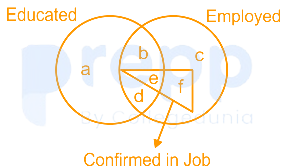
Read the given figure and find the region representing persons who are educated and employed but not confirmed in job.
The magazine in which Mahatma Gandhi mentioned what he wanted the Constitution to do is:
Which gas shields the surface of the earth from ultraviolet radiation from the sun?
Which event is marked as an Intangible Cultural Heritage of Humanity by UNESCO?
Who has been conferred with the rank of the Commander of the Order of the British Empire in 2018?


