
Which one of the following statements is false?
Regression coefficient of the two variables may have different algebraic symbols for real life situations
Analyzing Regression and Correlation Properties
The question asks us to identify the false statement among the given options concerning regression coefficients and the coefficient of correlation. Let's examine each statement based on the known properties of these statistical measures.
Examining Statement 1: Regression Coefficients and Change of Origin/Scale
The first statement says that regression coefficients are independent of change of origin but not of change of scale. Let the original variables be \(X\) and \(Y\). Suppose we perform a change of origin and scale to get new variables \(U = \frac{X - a}{c}\) and \(V = \frac{Y - b}{d}\), where \(a, b\) are changes in origin and \(c, d\) are changes in scale (\(c, d \neq 0\)).
The regression coefficient of \(Y\) on \(X\), denoted by \(b_{yx}\), is related to the regression coefficient of \(V\) on \(U\), denoted by \(b_{vu}\), by the formula:
\(b_{yx} = \frac{d}{c} b_{vu}\)
This formula shows that \(b_{yx}\) depends on the scale factors \(c\) and \(d\). If there is only a change of origin (\(c=1, d=1\)), then \(b_{yx} = b_{vu}\), meaning the coefficient is independent of the change of origin. If there is only a change of scale (\(a=0, b=0\)), then \(b_{yx} = \frac{d}{c} b_{vu}\), showing dependence on the scale. Therefore, statement 1 is true.
Examining Statement 2: Both Regression Coefficients Cannot Exceed One (Ignoring Sign)
The second statement claims that both regression coefficients cannot assume a value (ignoring algebraic sign) greater than one. Let the two regression coefficients be \(b_{yx}\) (regression of Y on X) and \(b_{xy}\) (regression of X on Y). A fundamental property relating regression coefficients and the correlation coefficient (\(r\)) is:
\(r^2 = b_{yx} \cdot b_{xy}\)
We know that the coefficient of correlation \(r\) must lie between \(-1\) and \(1\), i.e., \(-1 \le r \le 1\). Squaring this inequality gives \(0 \le r^2 \le 1\).
Substituting the relationship, we get \(b_{yx} \cdot b_{xy} \le 1\). The regression coefficients \(b_{yx}\) and \(b_{xy}\) must always have the same sign as the correlation coefficient \(r\). Thus, their product \(b_{yx} \cdot b_{xy}\) is always non-negative, which is consistent with \(r^2\).
Now, consider the values ignoring the algebraic sign, i.e., \(|b_{yx}|\) and \(|b_{xy}|\). Since \(b_{yx}\) and \(b_{xy}\) have the same sign, \(|b_{yx} \cdot b_{xy}| = |b_{yx}| \cdot |b_{xy}|\). And since \(r^2 = b_{yx} \cdot b_{xy}\), we have \(r^2 = |b_{yx}| \cdot |b_{xy}|\).
Given \(r^2 \le 1\), it implies \(|b_{yx}| \cdot |b_{xy}| \le 1\).
If both \(|b_{yx}| > 1\) and \(|b_{xy}| > 1\), then their product \(|b_{yx}| \cdot |b_{xy}|\) would be greater than \(1 \times 1 = 1\). This contradicts the condition \(|b_{yx}| \cdot |b_{xy}| \le 1\). Therefore, it is not possible for both regression coefficients to have magnitudes greater than one simultaneously. Statement 2 is true.
Examining Statement 3: Regression Coefficients Having Different Algebraic Symbols
The third statement says that the regression coefficients of the two variables may have different algebraic symbols (signs) for real-life situations. The regression coefficient of \(Y\) on \(X\) is given by \(b_{yx} = r \frac{\sigma_y}{\sigma_x}\), and the regression coefficient of \(X\) on \(Y\) is given by \(b_{xy} = r \frac{\sigma_x}{\sigma_y}\), where \(\sigma_x\) and \(\sigma_y\) are the standard deviations of \(X\) and \(Y\), respectively. Standard deviations are always non-negative (\(\sigma_x \ge 0, \sigma_y \ge 0\)). Assuming \(\sigma_x > 0\) and \(\sigma_y > 0\) (for non-constant variables), the signs of \(b_{yx}\) and \(b_{xy}\) are determined solely by the sign of the correlation coefficient \(r\).
- If \(r > 0\), then \(b_{yx} > 0\) and \(b_{xy} > 0\). Both are positive.
- If \(r < 0\), then \(b_{yx} < 0\) and \(b_{xy} < 0\). Both are negative.
- If \(r = 0\), then \(b_{yx} = 0\) and \(b_{xy} = 0\). Both are zero.
In all cases, the regression coefficients \(b_{yx}\) and \(b_{xy}\) must have the same algebraic sign. The statement that they "may have different algebraic symbols" is therefore false.
Examining Statement 4: Correlation Coefficient and Change of Origin/Scale
The fourth statement says that the coefficient of correlation is independent of the change of origin and scale of data. This is a fundamental property of the correlation coefficient. Let \(r_{xy}\) be the correlation between \(X\) and \(Y\), and \(r_{uv}\) be the correlation between \(U = \frac{X - a}{c}\) and \(V = \frac{Y - b}{d}\).
Provided that the scale factors \(c\) and \(d\) are positive (\(c > 0, d > 0\)), the correlation remains unchanged:
\(r_{uv} = r_{xy}\)
If one or both scale factors are negative, the magnitude of the correlation remains the same, but the sign might flip if only one is negative. However, the statement refers to "change of origin and scale" generally. Standard definitions and properties confirm independence from origin and positive scale changes. With positive scale changes, the coefficient is exactly the same. The statement is generally considered true in this context.
Conclusion: Identifying the False Statement
Based on our analysis:
- Statement 1: True (Independent of origin, dependent on scale)
- Statement 2: True (Both magnitudes cannot exceed 1)
- Statement 3: False (Regression coefficients must have the same sign)
- Statement 4: True (Independent of origin and positive scale)
The false statement is that the regression coefficient of the two variables may have different algebraic symbols for real life situations.
| Statement | Property | Truth Value |
|---|---|---|
| 1. Regression coefficients & origin/scale | Independent of origin, dependent on scale | True |
| 2. Both regression coefficients magnitude > 1 | Cannot both have magnitude > 1 | True |
| 3. Regression coefficients & different signs | Must have the same sign (as \(r\)) | False |
| 4. Correlation coefficient & origin/scale | Independent of origin and positive scale | True |
Revision Table: Regression and Correlation Properties
| Property | Regression Coefficients (\(b_{yx}, b_{xy}\)) | Correlation Coefficient (\(r\)) |
|---|---|---|
| Change of Origin | Independent | Independent |
| Change of Scale | Dependent (by factor d/c or c/d) | Independent (for positive scale) |
| Sign | Must have the same sign as \(r\) | Determines the sign of regression coefficients |
| Relationship | \(r^2 = b_{yx} \cdot b_{xy}\) | \(r = \pm \sqrt{b_{yx} \cdot b_{xy}}\) (sign is same as regression coefficients) |
| Magnitude Constraint | Cannot both have magnitude > 1 | Magnitude always \(\le 1\) (\(-1 \le r \le 1\)) |
Additional Information: Understanding Regression and Correlation
Regression Analysis: This statistical method is used to estimate the relationship between a dependent variable and one or more independent variables. Linear regression fits a straight line to the data. There are two regression lines for two variables \(X\) and \(Y\): Regression of Y on X (predicting Y from X) and Regression of X on Y (predicting X from Y).
- Regression Coefficient (\(b\)): Represents the average change in the dependent variable for a one-unit change in the independent variable. \(b_{yx}\) is the slope of the regression line of Y on X, and \(b_{xy}\) is the slope of the regression line of X on Y.
Correlation Analysis: This statistical method measures the strength and direction of the linear relationship between two variables.
- Correlation Coefficient (\(r\)): A standardized measure of the linear association, ranging from -1 to +1.
- \(r = +1\): Perfect positive linear correlation.
- \(r = -1\): Perfect negative linear correlation.
- \(r = 0\): No linear correlation.
Change of Origin: Adding or subtracting a constant value to all observations of a variable. This shifts the data points on the axis but doesn't change their relative positions or spread.
Change of Scale: Multiplying or dividing all observations of a variable by a non-zero constant. This stretches or compresses the data points on the axis, changing their spread and relative positions if the scale factor is different for the two variables.
Understanding how these measures behave under transformations like change of origin and scale is crucial in interpreting statistical results correctly, especially when working with transformed data.
Important Questions from Miscellaneous
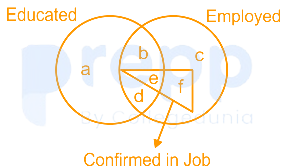
Read the given figure and find the region representing persons who are educated and employed but not confirmed in job.
The magazine in which Mahatma Gandhi mentioned what he wanted the Constitution to do is:
Which gas shields the surface of the earth from ultraviolet radiation from the sun?
Which event is marked as an Intangible Cultural Heritage of Humanity by UNESCO?
Who has been conferred with the rank of the Commander of the Order of the British Empire in 2018?


