
Which one of the following measures better explains inflation in an economic ecosystem?
Rate of change in GNP deflator
Understanding Inflation Measures in Economics
Inflation is a key economic concept that refers to the general increase in the prices of goods and services in an economy over a period of time. When the general price level rises, each unit of currency buys fewer goods and services; consequently, inflation reflects a reduction in the purchasing power per unit of money – a loss of real value in the medium of exchange and unit of account within the economy.
To understand and manage inflation, economists use various measures. Let's examine the options provided:
Analysis of Inflation Measures
- Consumer Price Index (CPI): This measures the average change over time in the prices paid by urban consumers for a market basket of consumer goods and services. It reflects the cost of living for typical households.
- Wholesale Price Index (WPI): This measures the average change in the prices of goods sold in bulk by wholesale businesses to other businesses. It tracks price movements at the producer or wholesale level before goods reach the retail market.
- GNP Deflator: This is a broad measure of the price level. It is calculated as the ratio of nominal Gross National Product (GNP) to real GNP, multiplied by 100. It reflects the prices of all domestically produced final goods and services in the economy. The formula is often represented as:
\(\text{GNP Deflator} = \frac{\text{Nominal GNP}}{\text{Real GNP}} \times 100\)
- Rate of change in GNP deflator: This measures how much the GNP deflator has increased or decreased over a specific period, usually a year. This rate of change indicates the overall inflation rate across all final goods and services included in the GNP.
Comparing the Measures
While CPI and WPI measure price changes for specific baskets of goods (consumer goods or wholesale goods), the GNP deflator includes prices of all domestically produced final goods and services, including consumption goods, investment goods, government services, and exports. This makes the GNP deflator a more comprehensive measure of the overall price level change in the entire economy.
Inflation is defined as the *rate* at which the general level of prices for goods and services is rising. Therefore, simply looking at the GNP deflator's value at a single point in time tells us the current price level relative to a base year, but it's the *rate of change* of this deflator over time that quantifies the inflation rate.
For example, if the GNP deflator increases from 100 in Year 1 to 105 in Year 2, the rate of change (or inflation rate) is \(\frac{105 - 100}{100} \times 100\% = 5\%\).
Thus, the rate of change in the GNP deflator provides a broad measure of economy-wide inflation, capturing price changes across a wider range of goods and services than CPI or WPI alone, and specifically measuring the *rate* of price increase, which is the definition of inflation.
| Measure | Scope | What it explains about Inflation |
|---|---|---|
| CPI | Consumer goods/services | Change in cost of living for consumers |
| WPI | Wholesale goods | Price pressure at production/wholesale level |
| GNP Deflator | All final goods/services (domestically produced) | Overall price level relative to base year |
| Rate of change in GNP Deflator | All final goods/services (domestically produced) | Economy-wide inflation rate over time |
Based on this comparison, the measure that better explains inflation in the sense of the general rise in prices across the entire economic ecosystem over time is the rate of change in the GNP deflator.
Revision Table: Key Inflation Concepts
| Term | Definition |
|---|---|
| Inflation | General rise in prices, fall in purchasing value of money |
| Price Index | A measure of the average price level of a basket of goods/services relative to a base year |
| GNP Deflator Rate of Change | Percentage change in the GNP deflator over time, indicating the overall inflation rate |
Additional Information on Inflation Measurement
While the rate of change in the GNP deflator offers a broad view, CPI and WPI are also crucial tools for understanding specific aspects of price changes within the economy. CPI is particularly relevant for understanding the impact of inflation on household budgets and wage negotiations. WPI can indicate inflationary pressures building up earlier in the supply chain.
Different countries may rely more heavily on one index over others depending on their economic structure and policy focus. For instance, some countries primarily use CPI for inflation targeting, while others might monitor WPI closely for supply-side analysis. However, for a comprehensive look at overall price changes affecting all components of the national product, the GNP deflator (specifically its rate of change) is considered highly informative.
Important Questions from Miscellaneous
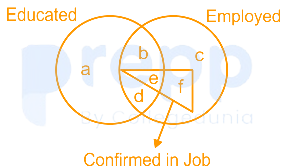
Read the given figure and find the region representing persons who are educated and employed but not confirmed in job.
The magazine in which Mahatma Gandhi mentioned what he wanted the Constitution to do is:
Which gas shields the surface of the earth from ultraviolet radiation from the sun?
Which event is marked as an Intangible Cultural Heritage of Humanity by UNESCO?
Who has been conferred with the rank of the Commander of the Order of the British Empire in 2018?


