
‘Which one of the following is the allowable deduction as per the Income Tax Act, 1961 in respect of entertainment allowance paid to a government employee?
Lower of one-fifth of basic salary or Rs. 5000 or entertainment allowance received
Understanding Entertainment Allowance Deduction for Government Employees
Entertainment allowance is a type of allowance paid by an employer to an employee to meet expenses incurred on entertaining customers or clients. Under the provisions of the Income Tax Act, 1961, the tax treatment of entertainment allowance depends on whether the employee is a government employee or a non-government employee.
Taxability of Entertainment Allowance
- For non-government employees, the entire amount of entertainment allowance received is added to their salary income and is fully taxable. No deduction is allowed.
- For government employees, the entertainment allowance received is first added to their salary income. However, they are eligible for a deduction under Section 16(ii) of the Income Tax Act, 1961.
Allowable Deduction for Government Employees
Section 16(ii) of the Income Tax Act, 1961, provides the rules for calculating the allowable deduction for entertainment allowance paid to a government employee. The deduction is the lowest of the following three amounts:
- The actual amount of entertainment allowance received during the financial year.
- A fixed statutory limit of & ब्याज; 5,000.
- One-fifth (1/5th) of the basic salary. For this purpose, 'salary' includes basic salary only and does not include any other allowances, benefits, or perquisites.
The amount of deduction is the minimum of these three values. This means a government employee can reduce their taxable salary income by this calculated amount.
Calculation of Deduction
The allowable deduction for entertainment allowance for a government employee is determined by the formula:
\( \text{Deduction} = \min \begin{cases} \text{Actual entertainment allowance received} \\ \text{& ब्याज; 5,000} \\ \frac{1}{5} \times \text{Basic Salary} \end{cases} \)
Let's look at the options provided in the question based on this rule:
- Option 1 suggests "Lower of one-fourth of basic salary or Rs. 5000 or entertainment allowance received". This uses one-fourth (\(1/4\)) of basic salary, which is incorrect.
- Option 2 suggests "Lower of one-fifth of basic salary or Rs. 5000 or entertainment allowance received". This correctly uses one-fifth (\(1/5\)) of basic salary, the fixed limit of & ब्याज; 5,000, and the actual allowance received.
- Option 3 suggests "Lower of one-fifth of salary or Rs. 5000 or entertainment allowance received." While it uses one-fifth, the term 'salary' here should specifically mean 'basic salary' for this calculation as per the rule. Option 2 is more precise by stating 'basic salary'.
- Option 4 suggests "Lower of one-fourth of salary or Rs. 5000 or entertainment allowance received." This again incorrectly uses one-fourth (\(1/4\)) of salary.
Comparing the options with the Income Tax Act, 1961 provisions regarding the entertainment allowance deduction for government employees, Option 2 accurately reflects the calculation criteria.
Revision Table: Key Points on Entertainment Allowance Deduction
| Aspect | Government Employee | Non-Government Employee |
|---|---|---|
| Initial Treatment | Fully taxable, added to salary | Fully taxable, added to salary |
| Deduction Eligibility | Yes, under Section 16(ii) | No deduction allowed |
| Deduction Amount (Govt.) | Lowest of:
|
N/A |
Additional Information: Understanding Salary Components
For tax purposes, 'salary' can have different meanings depending on the section of the Income Tax Act. When calculating the deduction for entertainment allowance under Section 16(ii), 'salary' specifically refers to basic salary. It does not include dearness allowance (unless it forms part of retirement benefits), commission, bonus, other allowances, or perquisites.
Other common allowances include House Rent Allowance (HRA), Dearness Allowance (DA), Transport Allowance, etc. Each allowance has its own specific tax rules regarding exemption or deduction.
- Basic Salary: The fundamental part of an employee's salary structure.
- Dearness Allowance (DA): An allowance paid to employees to compensate for the increasing cost of living.
- House Rent Allowance (HRA): An allowance paid by the employer to meet the cost of renting a house. It is eligible for exemption under Section 10(13A) with certain conditions.
Understanding the specific rules for different allowances and deductions is crucial for calculating taxable income correctly.
Important Questions from Miscellaneous
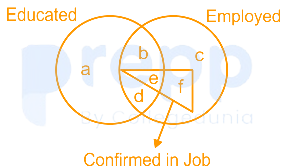
Read the given figure and find the region representing persons who are educated and employed but not confirmed in job.
The magazine in which Mahatma Gandhi mentioned what he wanted the Constitution to do is:
Which gas shields the surface of the earth from ultraviolet radiation from the sun?
Which event is marked as an Intangible Cultural Heritage of Humanity by UNESCO?
Who has been conferred with the rank of the Commander of the Order of the British Empire in 2018?


