
Which one of the following is invalid for the relationship among the agent, the sub-agent and the principal?
Sub-agent is responsible to the agent only
Understanding the Agent, Sub-agent, and Principal Relationship in Agency Law
In commercial law, an agency relationship involves three main parties: the Principal, the Agent, and sometimes a Sub-agent. The Principal authorizes the Agent to act on their behalf. The Agent, in turn, may sometimes appoint a Sub-agent to perform tasks related to the agency, but under the Agent's control and direction. Understanding the responsibilities and relationships among these parties is crucial.
Analyzing the Statements about Agent, Sub-agent, and Principal Relationship
Let's examine each statement provided in the options to determine which one is invalid for the relationship among the agent, the sub-agent, and the principal.
-
Statement 1: Sub-agent works under the control and on the directions of the agent
This statement is generally valid. A sub-agent is appointed by the agent and acts under the agent's supervision and instructions, not directly under the principal's, unless the agent is authorized to delegate and appoints the sub-agent as a substitute agent in specific circumstances (a substituted agent is different from a sub-agent).
-
Statement 2: Sub-agent is responsible to the agent only
This statement is invalid. While the sub-agent is primarily responsible to the agent who appointed them, they also owe duties to the principal. For example, a principal can hold a properly appointed sub-agent directly liable for fraud or willful wrong. Therefore, stating the sub-agent is responsible *only* to the agent is incorrect.
-
Statement 3: Privity of contract exists between the principle and the sub-agent
This statement is generally considered valid in the context of a properly appointed sub-agent. Although the sub-agent's contract is directly with the agent, agency law establishes a direct legal relationship (often referred to as privity for certain purposes like accountability) between the principal and a sub-agent appointed with the principal's authority (express or implied). The principal is bound by the acts of a properly appointed sub-agent, and the principal can enforce duties against the sub-agent.
-
Statement 4: Agent is responsible to the principle for the acts of the sub-agent
This statement is generally valid. When an agent appoints a sub-agent, the agent remains responsible to the principal for the acts of the sub-agent. The agent is accountable to the principal as if the sub-agent's actions were their own, especially if the sub-agent was appointed without proper authority or supervision.
Based on the analysis, the statement that is invalid for the relationship among the agent, the sub-agent, and the principal is that the Sub-agent is responsible to the agent only. The sub-agent has responsibilities towards the principal as well.
Summary of Relationships
| Relationship Aspect | Principal and Agent | Agent and Sub-agent | Principal and Sub-agent |
|---|---|---|---|
| Contractual Basis | Direct contract of agency | Direct contract between agent & sub-agent | Generally no direct contract of appointment, but legal relationship exists if sub-agent properly appointed |
| Control & Direction | Principal controls Agent | Agent controls Sub-agent | Indirect control through Agent; direct duties owed by Sub-agent |
| Responsibility | Agent responsible to Principal | Sub-agent responsible to Agent | Sub-agent can be directly liable to Principal for certain acts (e.g., fraud, willful wrong); Agent responsible for Sub-agent's acts to Principal |
| Privity | Yes | Yes | Yes, for purposes of accountability and direct action in certain cases (if sub-agent properly appointed) |
The statement that the sub-agent is responsible *only* to the agent is incorrect because the sub-agent also has a legal relationship and duties towards the principal, especially when appointed properly.
Conclusion on Invalid Statement
Therefore, the invalid statement is: Sub-agent is responsible to the agent only.
Revision Table: Key Concepts in Agency and Sub-agency
| Term | Definition | Key Responsibility |
|---|---|---|
| Principal | The person for whom an act is done by the agent. | Authorize agent, bound by agent's (and properly appointed sub-agent's) lawful acts. |
| Agent | A person employed to do any act for another, or to represent another in dealings with third persons. | Act for Principal, appoint sub-agent (if permitted), responsible to Principal for own acts and sub-agent's acts. |
| Sub-agent | A person employed by, and acting under the control of, the original agent in the business of the agency. | Act under Agent's direction, responsible to Agent, also owes duties to Principal. |
Additional Information on Sub-agent Responsibilities
According to sections of contract law dealing with agency (such as Sections 190-193 of the Indian Contract Act, 1872), when a sub-agent is properly appointed (i.e., the agent had authority to appoint a sub-agent):
- The principal is represented by the acts of the sub-agent as if the sub-agent were the original agent.
- The agent is responsible to the principal for the acts of the sub-agent.
- The sub-agent is responsible for their acts to the agent.
- The sub-agent is also directly responsible to the principal for acts of fraud or willful wrong.
This clarifies that a sub-agent's responsibility is not limited *only* to the agent, but extends to the principal in certain critical areas, making statement 2 invalid.
Important Questions from Miscellaneous
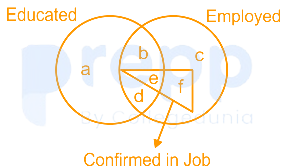
Read the given figure and find the region representing persons who are educated and employed but not confirmed in job.
The magazine in which Mahatma Gandhi mentioned what he wanted the Constitution to do is:
Which gas shields the surface of the earth from ultraviolet radiation from the sun?
Which event is marked as an Intangible Cultural Heritage of Humanity by UNESCO?
Who has been conferred with the rank of the Commander of the Order of the British Empire in 2018?


