
Which one of the following is CORRECT?
Understanding the Probable Error Formula for Correlation
The question asks us to identify the correct formula for a statistical measure denoted by 'PE', which involves the sample size 'n' and a value 'r'. This formula is a standard formula used in statistics, specifically related to the probable error of a correlation coefficient.
What is Probable Error (PE) of a Correlation Coefficient?
The correlation coefficient (often denoted by 'r') is a measure of the linear association between two variables. When we calculate a correlation coefficient based on a sample, it's just an estimate of the true correlation coefficient in the population. The Probable Error (PE) of the correlation coefficient 'r' indicates the extent to which the calculated 'r' from a sample might differ from the true population correlation coefficient. It helps in determining the reliability of the sample correlation coefficient.
Specifically, the Probable Error is defined such that there is a 50% chance that the true population correlation coefficient lies within the range \({\rm{r}} \pm {\rm{PE}}\).
The Standard Formula for Probable Error
For a correlation coefficient 'r' calculated from a sample of size 'n', the standard formula for its Probable Error (PE) is given by:
\({\rm{PE}}\,{\rm{ = }}\,0.6745 \times {\rm{Standard\, Error\, of\, r}}\)
The standard error of the correlation coefficient 'r' is approximately:
\({\rm{SE}}_{\rm{r}} \,{\rm{ = }}\,\frac{{1\, - \,{{\rm{r}}^2}}}{{\sqrt {\rm{n}}}}\)
Combining these, the formula for the Probable Error (PE) of the correlation coefficient is:
\({\rm{PE}}\,{\rm{ = }}\,0.6745 \times \frac{{1\, - \,{{\rm{r}}^2}}}{{\sqrt {\rm{n}}}}\)
This can be written as:
\({\rm{PE}}\,{\rm{ = }}\,\frac{{0.6745\left( {1\, - \,{{\rm{r}}^2}} \right)}}{{\sqrt {\rm{n}}}}\)
Analyzing the Given Options
Let's compare the derived standard formula with the given options:
| Option | Formula | Comparison with Standard Formula |
|---|---|---|
| 1 | \({\rm{PE}}\,{\rm{ = }}\,\frac{{.6475\left( {1\, - \,{{\rm{r}}^2}} \right)}}{{\sqrt {\rm{n}} }}\) | Uses 0.6475 instead of the correct constant 0.6745. |
| 2 | \({\rm{PE}}\,{\rm{ = }}\,\frac{{.6745\left( {1\, - \,{{\rm{r}}^2}} \right)}}{{\sqrt {\rm{n}} }}\) | Matches the standard formula for Probable Error of a correlation coefficient. |
| 3 | \({\rm{PE}}\,{\rm{ = }}\,\frac{{.6475\sqrt {\rm{n}} }}{{1\, - \,{{\rm{r}}^2}}}\) | The structure is incorrect, with \({\sqrt {\rm{n}}}\) in the numerator and \({\left( {1\, - \,{{\rm{r}}^2}} \right)}\) in the denominator. |
| 4 | \({\rm{PE}}\,{\rm{ = }}\,\frac{{{\rm{.6475}}\left( {{\rm{1}}\,{\rm{ - }}\,{{\rm{r}}^{\rm{2}}}} \right)}}{{\rm{n}}}\) | Uses 0.6475 instead of 0.6745 and has 'n' in the denominator instead of \({\sqrt {\rm{n}}}\). |
Based on the comparison, Option 2 correctly represents the standard formula for the Probable Error of a correlation coefficient 'r' based on a sample size 'n'. The constant 0.6745 is derived from the properties of the normal distribution (it is the quartile deviation in standard units, representing the point such that 50% of the area is within \(\pm 0.6745\) standard deviations from the mean).
Conclusion
The correct formula among the given options for the Probable Error (PE) of a correlation coefficient 'r' based on a sample size 'n' is \({\rm{PE}}\,{\rm{ = }}\,\frac{{.6745\left( {1\, - \,{{\rm{r}}^2}} \right)}}{{\sqrt {\rm{n}} }}\).
Revision Table: Key Statistical Formulas
| Term | Definition | Common Formula (Example: for Correlation Coefficient) |
|---|---|---|
| Correlation Coefficient (r) | Measures the linear relationship strength and direction between two variables. | Varies based on the specific formula (e.g., Pearson's r). |
| Sample Size (n) | The number of observations or data points in the sample. | n (a count) |
| Standard Error (SE) | The standard deviation of the sampling distribution of a statistic. Indicates precision of estimate. | \({\rm{SE}}_{\rm{r}} \,{\rm{ \approx }}\,\frac{{1\, - \,{{\rm{r}}^2}}}{{\sqrt {\rm{n}}}}\) (for correlation coefficient r) |
| Probable Error (PE) | A measure of statistical dispersion, representing the range around a statistic where 50% of the true values are expected to lie. | \({\rm{PE}}\,{\rm{ = }}\,0.6745 \times {\rm{SE}}\) \({\rm{PE}}_{\rm{r}}\,{\rm{ = }}\,\frac{{0.6745\left( {1\, - \,{{\rm{r}}^2}} \right)}}{{\sqrt {\rm{n}}}}\) (for correlation coefficient r) |
Additional Information on Probable Error and Correlation
The concept of Probable Error is somewhat less common in modern statistics compared to standard errors and confidence intervals, but it's still relevant in historical context and some applications. Here's a bit more detail:
- Significance of Probable Error: If the calculated correlation coefficient 'r' is less than its Probable Error (r < PE), the correlation is generally considered insignificant, meaning it could easily have occurred by chance. If r is greater than 6 times its Probable Error (r > 6 * PE), the correlation is considered highly significant.
- Relation to Standard Error: The constant 0.6745 is the relationship between the quartile deviation and the standard deviation in a normal distribution (approximately). Since the standard error is a standard deviation of a sampling distribution, multiplying it by 0.6745 gives the probable error.
- Assumptions: The formula for the standard error of 'r' (and thus the Probable Error) assumes that the variables are normally distributed and that the true population correlation is close to zero. For larger population correlations, more complex transformations (like Fisher's z-transformation) might be used to estimate standard error or construct confidence intervals.
- Use Case: Probable error is primarily used with the Pearson product-moment correlation coefficient. It helps researchers quickly gauge the reliability of their observed correlation based on sample size.
Important Questions from Miscellaneous
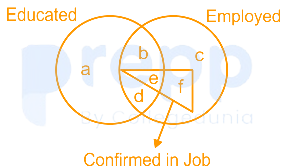
Read the given figure and find the region representing persons who are educated and employed but not confirmed in job.
The magazine in which Mahatma Gandhi mentioned what he wanted the Constitution to do is:
Which gas shields the surface of the earth from ultraviolet radiation from the sun?
Which event is marked as an Intangible Cultural Heritage of Humanity by UNESCO?
Who has been conferred with the rank of the Commander of the Order of the British Empire in 2018?


