
Which one of the following concepts measures the amount of capital thal the firm can give up by using one additional unit of labour and still remain on the same isoquant?
Diminishing Marginal Rate of Technical Substitution
Understanding Production Isoquants and Factor Substitution
In economics, particularly in the study of production, an isoquant is a contour line drawn through the set of points at which the same quantity of output is produced while changing the quantities of two or more inputs, such as capital and labour. It represents the different combinations of inputs that yield the same level of output.
Defining the Marginal Rate of Technical Substitution (MRTS)
The question asks about the amount of capital a firm can give up by using one additional unit of labour while remaining on the same isoquant. This concept is precisely defined by the Marginal Rate of Technical Substitution (MRTS).
The MRTS is the rate at which one input (say, capital) can be substituted for another input (say, labour) while keeping the level of output constant. It is calculated as the absolute value of the slope of the isoquant at a particular point.
Mathematically, if $\Delta L$ represents the change in labour and $\Delta K$ represents the change in capital, the MRTS of labour for capital (MRTS$_{L,K}$) is:
\(\text{MRTS}_{L,K} = - \frac{\Delta K}{\Delta L}\)
This formula tells us how many units of capital ($\Delta K$) can be reduced for a one-unit increase in labour ($\Delta L = 1$), while staying on the same isoquant (meaning output doesn't change).
Diminishing Marginal Rate of Technical Substitution
The term "Diminishing" applied to the MRTS refers to the typical assumption that as a firm increases the use of one input (e.g., labour) and reduces the use of another (e.g., capital) while staying on the same isoquant, the amount of the input being reduced that can be substituted for one additional unit of the increasing input becomes smaller and smaller. In simpler terms, as you hire more and more labour and use less and less capital, each additional worker replaces progressively smaller amounts of capital.
This diminishing nature is why isoquants are typically convex to the origin.
Analyzing the Options
Let's look at the provided options:
- Diminishing Marginal Rate of Substitution: This concept is related to consumer theory (indifference curves) and measures the rate at which a consumer is willing to substitute one good for another while maintaining the same level of utility. It uses goods as the variables, not inputs like capital and labour, and relates to utility, not production output. So, this is not the correct concept in the context of production with inputs.
- Economic Trade-off Region: This is a broader term that could refer to areas on production possibility frontiers or indifference curves where trade-offs occur, but it is not a specific measure of the rate of substitution between two inputs on an isoquant.
- Diminishing Marginal Rate of Technical Substitution: As discussed above, this concept precisely defines the rate at which capital can be substituted for labour while keeping output constant (remaining on the same isoquant). The "diminishing" aspect describes the typical behaviour of this rate as inputs are substituted. This aligns perfectly with the question's description.
- Diminishing Marginal Utility: This concept is from consumer theory and states that as a consumer consumes more of a good, the additional utility gained from each extra unit decreases. It is unrelated to the substitution rate between production inputs on an isoquant.
Based on the definitions, the concept that measures the amount of capital that the firm can give up by using one additional unit of labour and still remain on the same isoquant is the Marginal Rate of Technical Substitution. The option correctly identifies this concept and its typical diminishing property.
Conclusion
The concept described in the question, which quantifies the substitution between capital and labour inputs along an isoquant while maintaining constant output, is the Marginal Rate of Technical Substitution (MRTS).
| Concept | Measures Substitution Between... | While Holding... Constant | Context |
|---|---|---|---|
| Marginal Rate of Technical Substitution (MRTS) | Production Inputs (e.g., Capital and Labour) | Output (Isoquant) | Production Theory |
| Marginal Rate of Substitution (MRS) | Consumption Goods | Utility (Indifference Curve) | Consumer Theory |
| Marginal Utility | Consumption of one Good | None specified (measures additional utility) | Consumer Theory |
Revision Table: Key Production Concepts
| Term | Definition | Relevance to Question |
|---|---|---|
| Isoquant | A curve showing all combinations of inputs (like labour and capital) that produce a given level of output. | The question is about movement along an isoquant. |
| Marginal Rate of Technical Substitution (MRTS) | The rate at which one input can be substituted for another while keeping output constant (slope of the isoquant). | Directly answers what the question is asking to measure. |
| Diminishing MRTS | The rate of substitution decreases as more of one input is used relative to the other along an isoquant. | Describes the typical shape/behaviour of the MRTS, as included in the correct option. |
Additional Information: Production Functions and Input Substitutability
The relationship between inputs and output is described by a production function, such as \(Q = f(L, K)\), where \(Q\) is the quantity of output, \(L\) is labour, and \(K\) is capital. Isoquants are derived from the production function.
The MRTS is also related to the marginal products of the inputs. The marginal product of labour (MPL) is the additional output produced by hiring one more unit of labour, holding capital constant. The marginal product of capital (MPK) is the additional output produced by using one more unit of capital, holding labour constant.
The MRTS of labour for capital can also be expressed as the ratio of the marginal product of labour to the marginal product of capital:
\(\text{MRTS}_{L,K} = \frac{\text{MP}_L}{\text{MP}_K}\)
The assumption of diminishing MRTS is related to the assumption of diminishing marginal returns to individual inputs and the convexity of the isoquants, which reflects that inputs are not perfect substitutes.
Important Questions from Miscellaneous
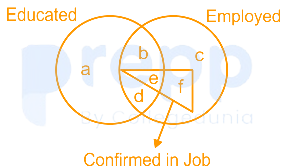
Read the given figure and find the region representing persons who are educated and employed but not confirmed in job.
The magazine in which Mahatma Gandhi mentioned what he wanted the Constitution to do is:
Which gas shields the surface of the earth from ultraviolet radiation from the sun?
Which event is marked as an Intangible Cultural Heritage of Humanity by UNESCO?
Who has been conferred with the rank of the Commander of the Order of the British Empire in 2018?


