
Which of the numbers (not digits) should be interchanged in the given equation to make it mathematically correct? 104 ÷ 4 - 6 + 13 × 5 = 22
13 and 4
Solving the Equation by Swapping Numbers
The problem asks us to find which pair of numbers in the given equation, \(104 \div 4 - 6 + 13 \times 5 = 22\), should be interchanged to make the equation mathematically correct.
First, let's evaluate the original equation using the order of operations (BODMAS/PEMDAS):
\(104 \div 4 - 6 + 13 \times 5\)
- Division: \(104 \div 4 = 26\)
- Multiplication: \(13 \times 5 = 65\)
Substitute these values back into the equation:
\(26 - 6 + 65\)
- Subtraction: \(26 - 6 = 20\)
- Addition: \(20 + 65 = 85\)
So, the original equation evaluates to \(85 = 22\), which is false. We need to swap numbers to achieve the result 22.
Testing the Options for Swapping Numbers
We will test each given option by interchanging the specified numbers and then evaluating the new equation.
Option 1: Interchange 13 and 4
If we swap 13 and 4, the equation becomes:
\(104 \div 13 - 6 + 4 \times 5\)
Now, let's evaluate this new equation using the order of operations:
- Division: \(104 \div 13 = 8\)
- Multiplication: \(4 \times 5 = 20\)
Substitute back into the equation:
\(8 - 6 + 20\)
- Subtraction: \(8 - 6 = 2\)
- Addition: \(2 + 20 = 22\)
The result is 22. So, \(22 = 22\). This option makes the equation correct.
Option 2: Interchange 6 and 4
If we swap 6 and 4, the equation becomes:
\(104 \div 6 - 4 + 13 \times 5\)
Evaluating this equation:
- Division: \(104 \div 6\) (This does not result in a whole number, which suggests this might not be the correct option if we expect integer results)
- Multiplication: \(13 \times 5 = 65\)
The equation is approximately \(17.33 - 4 + 65 = 13.33 + 65 = 78.33\). This is not 22.
Option 3: Interchange 6 and 5
If we swap 6 and 5, the equation becomes:
\(104 \div 4 - 5 + 13 \times 6\)
Evaluating this equation:
- Division: \(104 \div 4 = 26\)
- Multiplication: \(13 \times 6 = 78\)
Substitute back into the equation:
\(26 - 5 + 78\)
- Subtraction: \(26 - 5 = 21\)
- Addition: \(21 + 78 = 99\)
The result is 99. This is not 22.
Option 4: Interchange 13 and 6
If we swap 13 and 6, the equation becomes:
\(104 \div 4 - 13 + 6 \times 5\)
Evaluating this equation:
- Division: \(104 \div 4 = 26\)
- Multiplication: \(6 \times 5 = 30\)
Substitute back into the equation:
\(26 - 13 + 30\)
- Subtraction: \(26 - 13 = 13\)
- Addition: \(13 + 30 = 43\)
The result is 43. This is not 22.
Based on testing all options, interchanging 13 and 4 is the only swap that results in the equation being mathematically correct.
| Original Equation | Numbers Swapped | New Equation | Evaluated Result | Correct? |
|---|---|---|---|---|
| \(104 \div 4 - 6 + 13 \times 5 = 22\) | None | \(104 \div 4 - 6 + 13 \times 5\) | 85 | No |
| 13 and 4 | \(104 \div 13 - 6 + 4 \times 5\) | 22 | Yes | |
| 6 and 4 | \(104 \div 6 - 4 + 13 \times 5\) | \( \approx 78.33\) | No | |
| 6 and 5 | \(104 \div 4 - 5 + 13 \times 6\) | 99 | No | |
| 13 and 6 | \(104 \div 4 - 13 + 6 \times 5\) | 43 | No |
Revision Table: Key Concepts
| Concept | Description | Importance |
|---|---|---|
| Order of Operations (BODMAS/PEMDAS) | Rules defining the sequence for performing calculations in an expression: Brackets/Parentheses, Orders/Exponents, Division/Multiplication (from left to right), Addition/Subtraction (from left to right). | Ensures consistent and correct evaluation of mathematical expressions. Essential for solving equations accurately. |
| Interchanging Numbers | Swapping the positions of two numbers within an equation or expression. | Changes the outcome of the calculation and is the core operation required by this problem. |
| Equation Verification | Checking if the left side of an equation is equal to the right side after performing all calculations. | Confirms whether the equation is mathematically correct or not. |
Additional Information: Understanding Mathematical Equations and Operations
A mathematical equation is a statement that two expressions are equal. It uses an equals sign (=). The goal is often to find values that make the statement true or, as in this case, to manipulate the equation so it becomes true.
The operations in the equation are division (\(\div\)), subtraction (\(-\)), addition (\(+\)), and multiplication (\(\times\)). The order in which these operations are performed is critical and is governed by the order of operations rule (BODMAS or PEMDAS).
- BODMAS: Brackets, Orders (powers, square roots, etc.), Division and Multiplication (left-to-right), Addition and Subtraction (left-to-right).
- PEMDAS: Parentheses, Exponents, Multiplication and Division (left-to-right), Addition and Subtraction (left-to-right).
Applying this rule ensures that everyone gets the same answer when evaluating an expression. In this problem, by swapping numbers, we change the operands for these operations, thus changing the final result of the expression on the left side of the equation. We needed to find the swap that makes the left side equal to the right side (22).
This type of problem tests your understanding of basic arithmetic operations and the importance of the correct order of operations when solving mathematical expressions.
Important Questions from Logical Puzzle
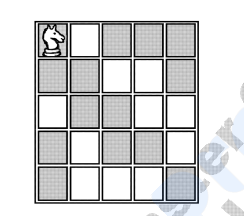
Below is given a figure, in which a horse is placed on one of the boxes in a square grid of size $5 \times 5$. The horse can move in either of the following ways in a single move:
(i) two boxes to either left or right side and one box to either up or down side
(ii) two boxes to either up or down side and one box to either left or right side
(iii) the horse cannot step on a grey box. The horse has to stay within the grid and any move to out of the grid is NOT legal.
How many white boxes are there which cannot be covered by horse within 3 moves?
- Six persons Raj, Rohit, Rachit, Rajat, Rishu, and Rinku are working in an office. Each of them has a favorite car viz. P, Q, R, S, T, and U, but not necessarily in the same order. Each of them got a different salary - 1000, 2000, 2500, 3000, 3500, and 4000, but not necessarily in the same order. Rajat gets a salary of 2500 and his favorite car is U. The one who likes car Q gets a salary of 3000. Rachit likes car P and gets a salary of 3500. The one who gets a salary of 1000 does not like car R or S. Rinku does not like car Q or S but gets a salary of 2000. Rishu gets a salary of 4000 and does not like a car R. Rohit does not get a salary of 1000. Who gets a salary of 3000?
- Six friends P, Q, R, S, T, and U are sitting at different positions in a row of the company, and each of them get a different salary viz – 500, 800, 1000, 1500, 1800 & 2000, but not necessary in the same order. The friend who gets a salary of 2000 does not sit at the extreme end of the row. Q sits immediately before R and gets a salary of 800. T sits between U and S. Q is second to the left of S. P sits at the left end of the row and gets a salary of 1000. T gets a salary of 1500. R gets a salary neither of 2000 nor of 1800. How much salary does U get?
- Seven men A, B, C, D, E, F and G are standing in a queue, one behind the other in that order. That is, A is first in queue while G brings up the rear. Each of them is wearing a hat of a different colour of the rainbow - Violet, Indigo, Blue, Green, Yellow, Orange, and Red, but not necessarily in that order. It is also known that:
• D can see in front of him green and blue hats, but not the violet hat.
• E can see violet and yellow hats, but not the red hat.
• G can see hats of all the colours except Orange.
• E is wearing the Indigo coloured hat.
What colour hat is worn by F? - Who amongst the females arrived third?


