
Understanding Clasts in Physical Contact
In geology, conglomerates are sedimentary rocks composed primarily of rounded fragments, known as clasts. The way these clasts are arranged and supported within the rock provides important information about how the rock formed.
The question specifically asks for the term used when these fragments, the clasts, are touching each other directly, establishing physical contact throughout the mass of the rock.
Defining Ortho Conglomerate
The correct term for a conglomerate where the clasts are in direct physical contact with each other, forming the main supporting structure of the rock, is Ortho conglomerate.
Key characteristics of an ortho conglomerate include:
- The larger fragments (clasts) are tightly packed and touch their neighbors.
- These clasts bear the load, meaning they support each other.
- The finer material, known as the matrix, fills the spaces remaining between the clasts but does not primarily support them.
Imagine a jar filled with tightly packed marbles; the marbles are the clasts in physical contact, and any space between them could be filled with sand (the matrix).
Distinguishing Other Conglomerate Classifications
Understanding the differences between the given options is key:
- Para conglomerate: This type of conglomerate is characterized by its matrix-supported framework. Here, the matrix holds the clasts apart, and the clasts are not necessarily in physical contact with each other. The matrix plays a significant role in supporting the weight.
- Intraformational conglomerate: This term relates to the origin of the clasts. An intraformational conglomerate consists of fragments derived from the erosion of older sedimentary layers within the *same* geological formation. While its clasts might be touching, the name emphasizes its depositional context rather than the specific clast arrangement (like physical contact).
- Oligomict conglomerate: This classification focuses on the composition of the clasts. An oligomict conglomerate contains clasts made up of predominantly one or very few rock types. This term describes the constituents, not the supportive structure or whether the clasts are in physical contact.
Conclusion on Clast Contact Terminology
Therefore, when the defining feature is that the clasts in a conglomerate are in physical contact throughout the rock, the appropriate term is Ortho conglomerate.
Important Questions from Miscellaneous
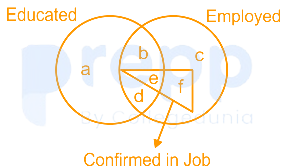
Read the given figure and find the region representing persons who are educated and employed but not confirmed in job.
The magazine in which Mahatma Gandhi mentioned what he wanted the Constitution to do is:
Which gas shields the surface of the earth from ultraviolet radiation from the sun?
Which event is marked as an Intangible Cultural Heritage of Humanity by UNESCO?
Who has been conferred with the rank of the Commander of the Order of the British Empire in 2018?


