
Which of the following statements is/are correct regarding child development? I. A child's cognitive and social development depends only on the environment II. Heredity is the only factor influential for the development of a child III. Heredity and environment are interrelated in the development of a child IV. The relative effects of heredity and environment vary in different areas of child development. Codes:
III and IV
Modern developmental psychology treats heredity (nature) and environment (nurture) as interacting influences: genes set a range of potential, and the environment determines how much of that potential is realised. Neither factor acts alone.
Statement I is incorrect: cognitive and social development do not depend only on the environment, because inherited factors such as temperament and neural maturation also shape them.
Statement II is incorrect: heredity is not the only influential factor; nutrition, stimulation, schooling and culture strongly affect development.
Statement III is correct: heredity and environment are interrelated, each modifying the effect of the other.
Statement IV is correct: the relative weight of the two differs by area; for example, physical traits such as height are more strongly influenced by heredity, while language and social behaviour depend more on the environment.
Only III and IV are correct, so every code that includes I or II fails.
III and IV option is correct.
Similar Questions
The value of the expression \((-3)^3 \times (0.3)^{-2} \times 0.01\) lies between which of the following ranges?
In a class test, a student earns 3 marks for every correct answer and loses 2 marks for every incorrect answer. No marks are given for questions left unattempted. If Radhika scored 20 marks and had 12 correct answers, how many questions did she attempt incorrectly?
If a polyhedron has 6 faces and 12 edges, what is the number of its vertices?
If \(a\) and \(b\) are positive integers (where \(b \neq 0\)) such that \(a^b = 1331\), then what is the value of \((a+b)^{a-b-8}\)?
Numbers that can be expressed as the sum of two cubes in two different ways are known as:
If \(x + \dfrac{y}{2} = \dfrac{1}{4}\), \(y + \dfrac{z}{2} = \dfrac{1}{4}\) and \(z + \dfrac{x}{2} = \dfrac{1}{4}\), then what is the value of \(x + y + z\)?
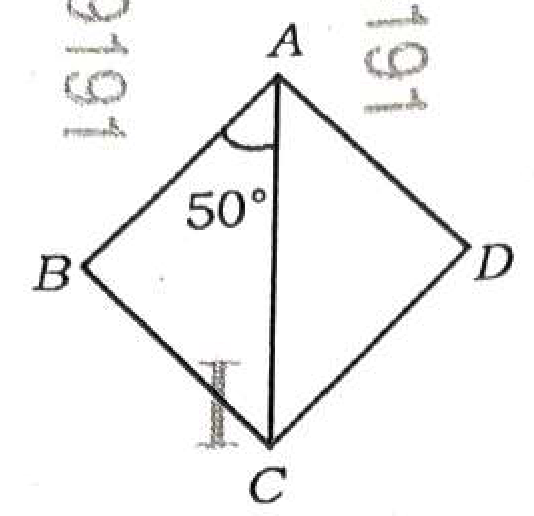
ABCD is a rhombus in which \(\angle BAC = 50^\circ\). What is the value of \(3\angle D - 2\angle DAC\)?
What is the value of \(\dfrac{\sqrt{450}}{\sqrt{338}} \div \dfrac{\sqrt{125}}{\sqrt{245}}\)?
The selling price of a toy is Rs. 1,020. If the profit made by the shopkeeper is 20%, what is the cost price of the toy?
The denominator of a rational number is greater than its numerator by 4. If 1 is added to both the numerator and the denominator, the resulting fraction is \(\dfrac{1}{2}\). Find the rational number.
Important Questions from Mixed Topic (JTET)
What type of process is thinking ?
The normal cause of origin of motivation is
How is impulse important for a teacher ?
The motive which forms due to social ideals, status, relations etc. is called
The learning in children starts from



