
Which of the following statement is correct? I . Securities transaction tax is a type of direct tax. II. Value-added tax is a type of indirect tax.
Understanding Direct and Indirect Taxes
Taxes are broadly classified into two main categories: direct taxes and indirect taxes. This classification depends on who bears the final burden of the tax.
- Direct Tax: A direct tax is levied directly on the income or wealth of individuals or organizations. The person or entity paying the tax to the government is the same person or entity on whom the tax is imposed. The burden of the tax cannot be shifted to another person. Examples include Income Tax, Wealth Tax, and Corporate Tax.
- Indirect Tax: An indirect tax is levied on goods and services. The tax is initially paid by the producer or seller, but they recover it by adding it to the price of the goods or services. The final burden of the tax is borne by the end consumer. Examples include Goods and Services Tax (GST), Value-Added Tax (VAT), Customs Duty, and Excise Duty.
Analyzing Securities Transaction Tax (STT)
Securities Transaction Tax (STT) is a tax levied in India on transactions done on the stock exchanges. This tax is applicable on the purchase and sale of equity shares, derivatives, equity-oriented mutual funds, and other specified securities. The tax is collected at the source by the exchange or the clearing corporation and paid to the government.
While STT is collected on transactions, the person undertaking the transaction (buyer or seller) is directly liable for this tax based on the value of their transaction. The burden of this tax falls directly on the transactor and is not shifted to a third party or consumer in the way indirect taxes are passed on through prices.
Based on the principle that the tax burden lies with the person on whom it is levied, STT is considered a type of direct tax.
Analyzing Value-Added Tax (VAT)
Value-Added Tax (VAT) was a consumption tax levied on the value added at each stage of production or distribution of goods and services in India before the implementation of GST. Although GST has largely replaced VAT in India, VAT is a classic example of an indirect tax.
In a VAT system, a manufacturer or seller pays VAT on their inputs and charges VAT on their sales. They then pay the government the difference between the VAT collected on sales and the VAT paid on inputs. However, the VAT charged on sales is ultimately added to the price paid by the final consumer, who bears the tax burden.
Since the tax burden is passed on from the producer/seller to the final consumer through the price of the goods or services, VAT is classified as an indirect tax.
Evaluating the Statements
Let's look at the given statements:
- Statement I: Securities transaction tax is a type of direct tax. Based on our analysis, STT is considered a direct tax because the burden is borne by the transactor. This statement is correct.
- Statement II: Value-added tax is a type of indirect tax. Based on our analysis, VAT is considered an indirect tax because the burden is passed on to the final consumer. This statement is correct.
Both statements are correct classifications based on the nature and incidence of the taxes mentioned.
Conclusion
Statement I correctly identifies Securities Transaction Tax (STT) as a direct tax, and Statement II correctly identifies Value-Added Tax (VAT) as an indirect tax. Therefore, both statements are correct.
Important Questions from Miscellaneous
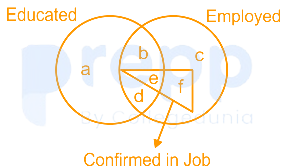
Read the given figure and find the region representing persons who are educated and employed but not confirmed in job.
The magazine in which Mahatma Gandhi mentioned what he wanted the Constitution to do is:
Which gas shields the surface of the earth from ultraviolet radiation from the sun?
Which event is marked as an Intangible Cultural Heritage of Humanity by UNESCO?
Who has been conferred with the rank of the Commander of the Order of the British Empire in 2018?


