
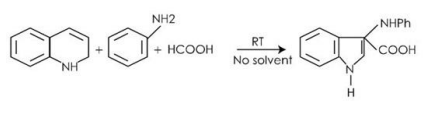
Green Chemistry Principle in Reactions
Green chemistry is a philosophy of chemical product and process design that applies to all stages of the chemical lifecycle. It aims to reduce or eliminate the use and generation of hazardous substances. This involves considering factors like waste prevention, atom economy, less hazardous syntheses, safer chemicals, safer solvents, energy efficiency, and the use of renewable resources. Let's analyze the given reactions to see which one best follows these principles.
Reaction Analysis: Option 1
This reaction involves the conversion of dichloromethane ( $\text{CH}_2\text{Cl}_2$ ) using sodium hydroxide ( $\text{NaOH}$ ) to produce methanol ( $\text{CH}_3\text{OH}$ ).
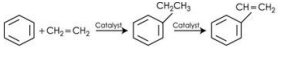
Issues from a Green Chemistry perspective:
- Dichloromethane ( $\text{CH}_2\text{Cl}_2$ ) is a halogenated solvent, often considered environmentally problematic and potentially hazardous. Green chemistry encourages the use of safer solvents or solvent-free processes (Principle 5).
Reaction Analysis: Option 2
This reaction shows an alkyl halide reacting with potassium cyanide ( $\text{KCN}$ ) to form an alkyl cyanide.

Issues from a Green Chemistry perspective:
- Potassium cyanide ( $\text{KCN}$ ) is extremely toxic. Green chemistry prioritizes the use and generation of substances with little or no toxicity (Principle 3 & 12).
Reaction Analysis: Option 3
This reaction depicts the oxidation of an alcohol using a strong oxidizing agent like potassium permanganate ( $\text{KMnO}_4$ ) in acidic conditions.
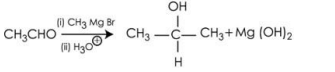
Issues from a Green Chemistry perspective:
- Potassium permanganate is a strong oxidizing agent, and its reactions often generate significant amounts of inorganic waste (e.g., $\text{MnO}_2$ ) as it's used stoichiometrically, not catalytically. This violates the principle of waste prevention (Principle 1) and the preference for catalysis (Principle 9).
Reaction Analysis: Option 4
This reaction involves the hydration of ethene ( $\text{C}_2\text{H}_4$ ) with steam (water) over a phosphoric acid catalyst supported on silica gel to produce ethanol ( $\text{C}_2\text{H}_5\text{OH}$ ).
Alignment with Green Chemistry Principles:
- Catalysis (Principle 9): The reaction uses a catalyst (phosphoric acid on silica) rather than a stoichiometric reagent. Catalysts increase reaction rates and selectivity, reducing waste and energy requirements, and are often used in small amounts.
- Safer Auxiliaries (Principle 5): Water (steam) is used as a reactant, which is a benign and environmentally friendly substance.
- Atom Economy (Principle 2): This addition reaction ideally incorporates all reactant atoms into the final product, leading to minimal waste if the reaction goes to completion.
- Less Hazardous Synthesis (Principle 3): While ethene is flammable, the overall process avoids highly toxic reagents like cyanides or harsh oxidizers and problematic solvents.
Conclusion: Green Chemistry Application
Comparing the options, the hydration of ethene to ethanol (Option 4) most closely embodies the principles of green chemistry, particularly through the use of catalysis and a benign co-reactant (water), while avoiding the highly toxic or polluting substances seen in the other options.
Important Questions from Environmental Chemistry - Teaching
Which of the following chemicals is used to cause artificial rain (cloud seeding)?
- Which is not a preferable characteristics of water to be used as green solvent ?
- For a green synthesis strategy choose the one which is not applicable.
- Out of the following two statements, identify the correct one(s) :
(a) An aqueous solution of sodium carbonate is alkaline.
(b) An aqueous solution of carbon dioxide is acidic. - The vapour pressure of bromobenzene above its ideal dilute aqueous solution of molality 0.1 mol $kg^{-1}$ is 24.0 kPa. Calculate the Henry's law constant of bromobenzene :


