
Which of the following options correctly represent new additions to improve the data quality by Census of India, 2011? A. Option of 'others'- other than male/female B. Tenure status of land under cultivation C. Tenancy status of agricultural land D. Four new codes on disability E. Information about rentiers Choose the correct answer from the options given below:
A, D and E only
Understanding Census of India 2011 Data Quality Improvements
The Census of India is a vital source of demographic and socio-economic data. Each census cycle introduces changes and improvements to enhance the accuracy, coverage, and quality of the data collected. The Census of India 2011 also brought in several new additions aimed at improving data quality and capturing a more nuanced picture of the population.
Detailed Analysis of Census 2011 New Additions
Let's examine each option provided to understand which were indeed new additions specifically aimed at improving data quality in the Census of India, 2011:
- A. Option of 'others'- other than male/female: This was a significant new addition in Census 2011. For the first time, the Census schedule explicitly included an option for persons identifying as 'Other' under the sex category, alongside male and female. This improved the data quality related to gender identification and recognized the existence of transgender and other non-binary individuals, ensuring better coverage and representation in the Census data.
- B. Tenure status of land under cultivation: While the Census does collect data related to household amenities and assets, focusing on land use and cultivation tenure status as a *new addition* specifically highlighted for *data quality improvement* in Census 2011 reports is less prominent compared to changes like the 'Other' gender option or expanded disability codes. Agricultural census often covers these aspects in more detail, but the decadal population census's focus on this specific detail as a *new quality improvement* is questionable based on key reported changes for 2011.
- C. Tenancy status of agricultural land: Similar to option B, the tenancy status of agricultural land is an important demographic detail, but its inclusion as a *new addition for improving data quality* in the 2011 Population Census, specifically, is not as widely cited a change as the 'Other' gender option or disability categories.
- D. Four new codes on disability: Census 2011 introduced a more detailed classification for disability. Previously, the categories were fewer. In 2011, new categories were added, significantly expanding the granularity of disability data collected. This allowed for a much clearer understanding of the types of disabilities prevalent in the population, thereby vastly improving the quality and utility of disability statistics. These new codes or categories helped capture a more accurate number and profile of persons with disabilities.
- E. Information about rentiers: This option likely refers to improved or more detailed data collection regarding sources of income or economic activity related to renting out property or living on rent income. Census 2011 did refine questions on economic activity and source of income, potentially including better ways to identify individuals whose primary income comes from rent or who own properties for rental income. Enhancing this data point improves the quality of socio-economic information collected, providing better insights into economic stratification and housing dynamics. Based on the provided correct option, this information seems to have been considered a new addition for quality improvement.
Correct New Additions in Census of India 2011 for Data Quality
Based on the analysis of significant changes introduced in the Census of India, 2011, aimed at improving data quality, the following options are considered correct new additions:
Option A: Inclusion of 'Other' sex category.
Option D: Introduction of four new codes/categories for disability.
Option E: Improved information collection regarding rentiers (likely linked to economic activity/income/housing data).
Therefore, the combination A, D, and E represents the correct set of new additions to improve data quality in Census of India, 2011, from the given list.
Revision Table: Census 2011 Data Quality Focus
| Option | Description | Status in Census 2011 (as per correct answer) | Impact on Data Quality |
|---|---|---|---|
| A | Option of 'others' for sex | New Addition | Improved gender data inclusivity and accuracy. |
| B | Tenure status of land under cultivation | Not considered a key new quality addition from list A, D, E | Not highlighted as a primary new improvement for quality in 2011 Population Census. |
| C | Tenancy status of agricultural land | Not considered a key new quality addition from list A, D, E | Not highlighted as a primary new improvement for quality in 2011 Population Census. |
| D | Four new codes on disability | New Addition | Improved granularity and accuracy of disability statistics. |
| E | Information about rentiers | New Addition | Improved socio-economic data, potentially relating to income source/housing. |
Additional Information on Census of India 2011
The Census of India 2011 was the 15th National Census survey in India. It was conducted in two phases: House Listing & Housing Census (April to September 2010) and Population Enumeration (February 2011). Besides the quality improvements mentioned, the 2011 Census also saw the first time biometric information (photograph and fingerprints) was collected during the House Listing phase as part of the National Population Register (NPR) exercise, which is linked but distinct from the Census itself. The Census aims to collect comprehensive data on demography, economic activity, literacy and education, housing and household amenities, urbanisation, fertility and mortality, scheduled castes and scheduled tribes, language, religion, migration, and disability.
Improving data quality in a large-scale operation like the Census is crucial for accurate policymaking, planning, and resource allocation across various sectors, including social welfare, health, education, and infrastructure.
Important Questions from Miscellaneous
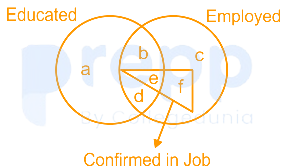
Read the given figure and find the region representing persons who are educated and employed but not confirmed in job.
The magazine in which Mahatma Gandhi mentioned what he wanted the Constitution to do is:
Which gas shields the surface of the earth from ultraviolet radiation from the sun?
Which event is marked as an Intangible Cultural Heritage of Humanity by UNESCO?
Who has been conferred with the rank of the Commander of the Order of the British Empire in 2018?


