
Which of the following numbers will replace the question mark (?) in the given series? 43, 45, 48, 53, 60, 71, ?
84
Finding the Pattern in a Number Series: 43, 45, 48, 53, 60, 71, ?
This question asks us to identify the number that should replace the question mark in the given series: 43, 45, 48, 53, 60, 71, ? To solve this type of number series problem, we need to look for a pattern or rule that connects the consecutive terms.
Let's examine the differences between the adjacent numbers in the series:
- Difference between the 2nd and 1st term: $45 - 43 = 2$
- Difference between the 3rd and 2nd term: $48 - 45 = 3$
- Difference between the 4th and 3rd term: $53 - 48 = 5$
- Difference between the 5th and 4th term: $60 - 53 = 7$
- Difference between the 6th and 5th term: $71 - 60 = 11$
The differences we found are 2, 3, 5, 7, 11. Let's look at this sequence of differences: 2, 3, 5, 7, 11. Do you recognize this sequence?
These numbers are the first few prime numbers in ascending order.
A prime number is a natural number greater than 1 that has no positive divisors other than 1 and itself. The sequence of prime numbers starts with 2, 3, 5, 7, 11, 13, 17, 19, and so on.
Since the differences are following the sequence of prime numbers, the next difference should be the next prime number after 11.
The next prime number after 11 is 13.
Therefore, the number replacing the question mark (?) will be the last term (71) plus the next difference (13).
Next term = $71 + 13 = 84$
So, the number that replaces the question mark is 84. The series continues as 43, 45, 48, 53, 60, 71, 84.
| Term | Value | Difference from Previous Term |
|---|---|---|
| 1st | 43 | - |
| 2nd | 45 | $45 - 43 = 2$ (Prime) |
| 3rd | 48 | $48 - 45 = 3$ (Prime) |
| 4th | 53 | $53 - 48 = 5$ (Prime) |
| 5th | 60 | $60 - 53 = 7$ (Prime) |
| 6th | 71 | $71 - 60 = 11$ (Prime) |
| 7th | ? | Next Prime: 13 |
Thus, the missing number is $71 + 13 = 84$.
Revision Table: Analyzing Number Series Patterns
Understanding different types of patterns is key to solving number series questions. Here are a few common types:
- Arithmetic Series: Constant difference between terms. E.g., 2, 4, 6, 8... (difference is 2)
- Geometric Series: Constant ratio between terms. E.g., 2, 4, 8, 16... (ratio is 2)
- Difference Series: The differences between terms follow a pattern (arithmetic, geometric, prime numbers, squares, cubes, etc.). This was the case in our problem.
- Mixed Series: More than one pattern might be involved, or the pattern might alternate.
- Prime Number Series: The terms themselves are prime numbers, or the pattern involves prime numbers.
Additional Information: Identifying Prime Numbers for Series
Being able to quickly identify prime numbers is helpful for solving number series based on prime differences or terms. Here's a list of the first few prime numbers:
$2, 3, 5, 7, 11, 13, 17, 19, 23, 29, 31, 37, 41, 43, 47, 53, 59, 61, 67, 71, 73, 79, 83, 89, 97, \dots$
In our problem, the sequence of differences was exactly the start of this prime number sequence: 2, 3, 5, 7, 11. The next number in this prime sequence is 13, which was our next difference.
Important Questions from Missing Number
Select the number that can replace the question mark (?) in the following pattern.
5
6
7
8
9
115
206
?
502
719
What function does the public key serve in digital signature verification?
Which of the following is an example of multi-factor authentication for PC security?
Find the missing term in the following question:
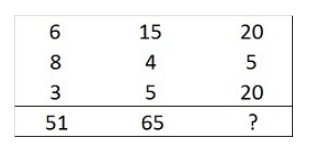
What number will come in place of question mark in this series?
100, 115, ?, 150, 170, 185
A. 135
B. 130
C. 140
D. 145


