
Which of the following functions represent(s) the output of the CMOS logic-gate shown in the circuit below?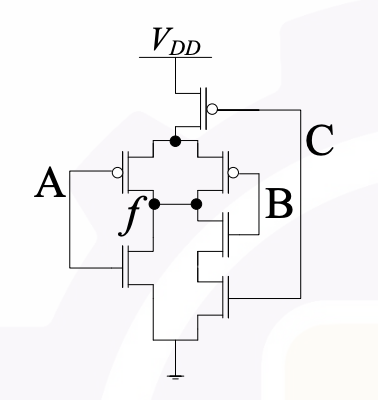
The given question involves determining the output function of a CMOS logic gate circuit. Let's analyze the circuit step-by-step:
In a CMOS logic gate circuit, the PMOS transistors pull the output up to the supply voltage \(V_{DD}\) (logic '1') and the NMOS transistors pull it down to ground (logic '0'). To derive the output expression, we follow these steps:
- Identify the series and parallel connections of NMOS and PMOS transistors from the circuit diagram.
- The PMOS network determines when the output is '1'. In this structure:
- The PMOS transistors are in parallel, so any high signal will turn the output to '1'.
- The NMOS network ensures the output is '0'. In this structure:
- The NMOS transistors are in series, so all inputs need to be high for the output to be '0'.
- From the circuit, we deduce:
- In the PMOS network: Two transistors are connected such that input A inverts (positive connection) and inputs B and C are in NAND configuration.
- In the NMOS network: Input A directly drives an NMOS, and inputs B and C are connected in series (AND configuration).
Based on the configuration above, the CMOS logic function can be represented by De Morgan's Theorems:
The NMOS series configuration implies a NOR gate function of inputs B and C: \( \overline{B \cdot C} \).
The overall function from the CMOS is complementary to the NMOS configuration: \( f = \overline{A + (B \cdot C)} \). This is confirmed as the behavioral output function for the circuit.
Therefore, the correct function representing the CMOS logic gate is:
\(f = \overline{\text{A} + \text{B}\text{C}}\)
Important Questions from Logic Gates
A two-input logic gate is giving high output only when both the inputs are high. For all other input conditions, the output is low. Select the correct logic gate.
The output is high only if one of the input is high. The above statement represents _____
The number of gate inputs, required to realize expression ABC + AB̅CD + EF̅ + AD is
Which of the following is logically equivalent?
A. ¬p → (q → r) and q → (p ∨ r)
B. (p → q) → r and p → (q → r)
C. (p → q) → (r → s) and (p → r) → (q → s)
Choose the correct answer from the options given below :
Consider the expression Y = P ⨁ Q ⨁ R where P, Q, R are the input variables and Y is the output variable. Y will be logic 0 if
(A) an odd number of input variables are 1
(B) an even number of input variables are 1
(C) an odd number of inputs variables are 0
(D) an even number of input variable are 0
(E) an odd number of input variable between 0 and 1
Choose the correct answer from the options given below:


