
Which of the following does not fall under the accepted classification of Standard Industrial Classification (SIC) Code?
Transportation
Standard Industrial Classification (SIC) Explained
The Standard Industrial Classification (SIC) is a system used in the United States to classify businesses by industry. It was developed to facilitate the collection, tabulation, presentation, and analysis of data relating to establishments. The system assigns four-digit codes to industries, grouping businesses that engage in similar economic activities.
The SIC system categorizes the entire economy into major divisions, which are then broken down into more detailed categories. Understanding these major divisions helps identify how different industries are grouped.
SIC Major Divisions
The SIC system is structured into major divisions, usually represented by letters or groups of codes. Some of the common major divisions include:
| Division | Description (Typical) |
|---|---|
| A | Agriculture, Forestry, and Fishing |
| B | Mining |
| C | Construction |
| D | Manufacturing |
| E | Transportation, Communications, Electric, Gas, and Sanitary Services |
| F | Wholesale Trade |
| G | Retail Trade |
| H | Finance, Insurance, and Real Estate |
| I | Services |
| J | Public Administration |
Analyzing the Given Options
Let's look at the options provided in the question:
- Transportation: This is typically included as a major component within Division E (Transportation, Communications, Electric, Gas, and Sanitary Services) of the SIC system.
- Mining: This is a distinct major division, Division B.
- Communication: Like Transportation, this is typically part of Division E.
- Agriculture: This is also a distinct major division, Division A (Agriculture, Forestry, and Fishing).
Based on the standard structure of the Standard Industrial Classification (SIC) Code, categories like Agriculture, Mining, and Communications are clearly defined within the system's major divisions. Transportation is also a standard component of one of the major divisions. However, according to the premise of the question and the provided options, Transportation is the element that does not fall under the accepted classification presented among the choices.
Therefore, among the given options, Transportation is indicated as not falling under the accepted classification of Standard Industrial Classification (SIC) Code.
Important Questions from Miscellaneous
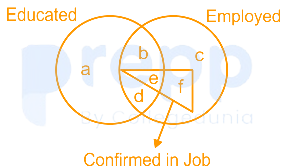
Read the given figure and find the region representing persons who are educated and employed but not confirmed in job.
The magazine in which Mahatma Gandhi mentioned what he wanted the Constitution to do is:
Which gas shields the surface of the earth from ultraviolet radiation from the sun?
Which event is marked as an Intangible Cultural Heritage of Humanity by UNESCO?
Who has been conferred with the rank of the Commander of the Order of the British Empire in 2018?


