
Which of the following are elements of induction? A. General statements B. Suggesting a regular association between two or more variables C. Conclusion is the starting point D. Derived from a series of empirical observations E. Firm conclusion Choose the correct answer from the options given below:
Understanding the Elements of Induction
Induction, or inductive reasoning, is a method of reasoning where specific observations are used to arrive at a general conclusion. It moves from specific instances to a general statement or principle.
Let's analyze each statement to determine if it is an element of induction:
- Statement A: General statements Induction often *leads* to general statements, but the general statement itself is typically the *conclusion* of the inductive process, not the starting point or primary element driving the observation. While related, it's more of an outcome than a core element of the *process* of induction compared to observation or finding patterns.
- Statement B: Suggesting a regular association between two or more variables This is a key element of induction. Inductive reasoning involves observing specific instances to identify patterns, correlations, or regular associations between phenomena or variables. Based on these observed regularities, a general conclusion or hypothesis is formed.
- Statement C: Conclusion is the starting point This statement describes deduction, not induction. In deductive reasoning, you start with a general premise (which acts like a conclusion or established truth) and apply it to specific cases to reach a specific conclusion. Induction works the other way around, with the conclusion being the *end* result of observations.
- Statement D: Derived from a series of empirical observations This is a fundamental element of induction. Inductive reasoning is based on gathering data and evidence through empirical observation of specific cases. The general conclusion reached through induction is directly derived from these observations.
- Statement E: Firm conclusion Inductive conclusions are typically probable or likely, not firm or certain. Because induction moves from specific instances to a general rule, there's always the possibility that future observations might contradict the conclusion. A firm or certain conclusion is characteristic of valid deductive arguments where the conclusion necessarily follows from the premises.
Based on this analysis, the core elements of induction among the given statements are suggesting a regular association between variables (B) and being derived from empirical observations (D).
Let's look at the options provided:
- Option 1: A, B and C only (C is incorrect)
- Option 2: C, D and E only (C and E are incorrect)
- Option 3: B and D only (B and D are correct elements of induction)
- Option 4: B, D and E only (E is incorrect)
Therefore, the correct option consists of statements B and D only.
Revision Table: Induction vs. Deduction
| Feature | Induction | Deduction |
|---|---|---|
| Starting Point | Specific observations/instances | General premise/rule |
| Direction of Reasoning | From specific to general | From general to specific |
| Nature of Conclusion | Probable, likely, contingent | Certain (if valid premises) |
| Relation to Empirical Data | Based on empirical data | Can be based on logic/rules, not necessarily empirical |
Additional Information on Inductive Reasoning
Inductive reasoning is widely used in science, everyday life, and statistical analysis. It's how we form hypotheses and theories based on observed evidence.
For example, if you observe that every swan you have ever seen is white, you might inductively conclude that all swans are white. This conclusion is probable based on your observations, but it is not guaranteed to be true (as there are black swans).
The strength of an inductive argument depends on the quality and quantity of the observations. More numerous and varied observations generally lead to a stronger (more probable) inductive conclusion.
Important Questions from Miscellaneous
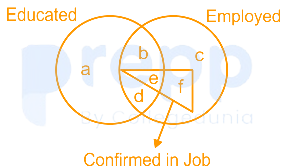
Read the given figure and find the region representing persons who are educated and employed but not confirmed in job.
The magazine in which Mahatma Gandhi mentioned what he wanted the Constitution to do is:
Which gas shields the surface of the earth from ultraviolet radiation from the sun?
Which event is marked as an Intangible Cultural Heritage of Humanity by UNESCO?
Who has been conferred with the rank of the Commander of the Order of the British Empire in 2018?


