
Arithmetic Series and Product Calculation
This problem involves calculating the sum of an arithmetic series and then adding a product term.
Step 1: Sum of the Arithmetic Series
The series is $1 + 3 + 5 + 7 + \dots + 4033$. This is an arithmetic progression (AP) consisting of consecutive odd numbers.
- First term ($a$): 1
- Common difference ($d$): 2
- Last term ($l$): 4033
To find the sum, we first need the number of terms ($n$). Use the AP formula: $l = a + (n-1)d$.
$4033 = 1 + (n-1)2$
Subtract 1 from both sides:
$4032 = (n-1)2$
Divide by 2:
$2016 = n-1$
Solve for $n$:
$n = 2017$
Now, calculate the sum ($S_n$) using the formula $S_n = \frac{n}{2}(a+l)$.
$S_{2017} = \frac{2017}{2}(1 + 4033)$
$S_{2017} = \frac{2017}{2}(4034)$
$S_{2017} = 2017 \times 2017$
$S_{2017} = 2017^2$
Step 2: Calculate the Product
The second part of the expression is the product: $7983 \times 2017$.
Step 3: Combine the Sum and Product
The total value required is $(1+3+5+...+4033) + 7983 \times 2017$.
Substitute the sum calculated in Step 1:
$ 2017^2 + 7983 \times 2017 $
Notice that 2017 is a common factor. Factor it out:
$ 2017 \times (2017 + 7983) $
Calculate the sum inside the parentheses:
$ 2017 \times (10000) $
Perform the final multiplication:
$ 20170000 $
The final value is 20170000.
Important Questions from Simplification (Notes)
- In the Delhi zoo, there are some ducks and rabbits. If the heads are counted there are 160, while the legs are 450. What will be number of ducks in the zoo ?
Identify the number that will replace the question mark in the second equation based on the relationship represented in the first equation.
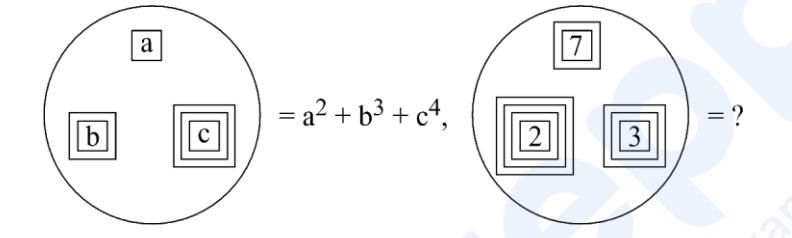
What value should come in the place of question mark (?) in the following equation?
$(0.008\div?) + (0.006 \div 0.03) + (0.008 \div 0.04) =0.5$If 'I' stands for '+', 'J' stands for 'x', 'K' stands for '÷', and 'L' stands for '-', then what will come in place of the question mark (?) in the following equation?
6 K 2 J 4 L 3 I 9 = ?If 'A' stands for '$\div $', 'B' stands for 'x', 'C' stands for '+' and 'D' stands for '-', then what will come in place of the question mark (?) in the following equation?
33 A 3 C 4 B 2 D 4 A 2 = ?


