
What is the objective of The MRTP Act, 1969? (a) No monopolies (b) To ensure that the operation of the economic system does not result in the concentration of economic power to the common detriment (c) To prohibit restrictive and unfair trade practices, which are prejudicial to public interest
All (a) (b) (c)
Understanding the MRTP Act, 1969 Objectives
The Monopolies and Restrictive Trade Practices (MRTP) Act was enacted in 1969 in India. The primary goal of the MRTP Act was to regulate economic activities to prevent concentration of economic power and to curb practices detrimental to public interest. Let's look at the potential objectives mentioned in the options:
Examining MRTP Act Objectives
- (a) No monopolies: While the Act aimed to control monopolistic practices and prevent their adverse effects, its objective was not to eliminate monopolies entirely. Rather, it sought to regulate them to ensure they did not operate against public interest. However, aiming for an environment free from harmful monopolies can be seen as an underlying goal.
- (b) To ensure that the operation of the economic system does not result in the concentration of economic power to the common detriment: This was a core objective of the MRTP Act. It aimed to prevent large businesses from accumulating excessive economic power that could harm competition, exploit consumers, or disadvantage smaller players in the market. This is directly mentioned in the preamble and provisions of the Act.
- (c) To prohibit restrictive and unfair trade practices, which are prejudicial to public interest: Another key objective of the MRTP Act was to identify and prohibit various trade practices that restrict competition or are unfair to consumers and businesses, thus harming public interest. Examples include price fixing, tied selling, misleading advertising, etc.
Based on the comprehensive scope of the MRTP Act, it addressed the issues outlined in points (b) and (c) directly. The Act aimed to control monopolistic practices and prevent the concentration of economic power to the detriment of society, while also prohibiting specific restrictive and unfair trade practices.
Considering the scope and purpose of the MRTP Act, all three statements capture different facets of its overall objectives, aiming to foster a fair and competitive economic environment and prevent consumer exploitation and concentration of wealth.
Important Questions from Miscellaneous
Read the given figure and find the region representing persons who are educated and employed but not confirmed in job.
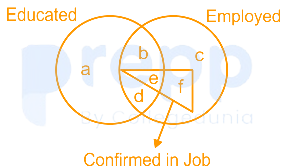
The magazine in which Mahatma Gandhi mentioned what he wanted the Constitution to do is:
Which gas shields the surface of the earth from ultraviolet radiation from the sun?
Which event is marked as an Intangible Cultural Heritage of Humanity by UNESCO?
Who has been conferred with the rank of the Commander of the Order of the British Empire in 2018?


