
What is the cutoff frequency of a first->order low-pass filter for $R_1 = 1.2 \ k\Omega$ and $C_1 = 0.02 \ \mu F$ ?
Calculating Cutoff Frequency for a First-Order Low-Pass Filter
This solution explains how to find the cutoff frequency ($f_c$) for a first-order low-pass filter given the resistance ($R_1$) and capacitance ($C_1$) values.
Given Parameters
- Resistance: $R_1 = 1.2 \ k\Omega = 1.2 \times 10^3 \ \Omega$
- Capacitance: $C_1 = 0.02 \ \mu F = 0.02 \times 10^{-6} \ F$
Filter Cutoff Frequency Formula
The cutoff frequency ($f_c$) for a simple RC low-pass filter is determined by the formula:
$f_c = \frac{1}{2\pi R C}$
Step-by-Step Calculation
-
Substitute the given values of $R_1$ and $C_1$ into the formula:
$f_c = \frac{1}{2\pi (1.2 \times 10^3 \ \Omega) (0.02 \times 10^{-6} \ F)}$
-
Calculate the product of resistance and capacitance (the time constant, $\tau$):
$R_1 C_1 = (1.2 \times 10^3) \times (0.02 \times 10^{-6}) = 24 \times 10^{-6} \ s$
-
Calculate the cutoff frequency:
$f_c = \frac{1}{2\pi (24 \times 10^{-6} \ s)} = \frac{1}{48\pi \times 10^{-6} \ s}$
$f_c \approx \frac{1}{150.796 \times 10^{-6}} \ Hz \approx 6631.45 \ Hz$
-
Convert the frequency to kilohertz (kHz):
$f_c \approx 6.63 \ kHz$
Conclusion
The calculated cutoff frequency for the first-order low-pass filter is approximately $6.63 \ kHz$.
Important Questions from Filters
The active filter works well
A band pass filter response has :
(a) Two critical frequencies
(b) Quality factor depends on the center frequency and the bandwidth
(c) Quality factor depends on the critical frequencies
(d) A voltage gainOptions :
A phase locked loop (PLL) consists of :
Which among the following has a frequency selective amplifier whose gain decreases from a finite value to zero as the frequency of the sinusoidal input increases from dc to infinity?
The direct form structure of an FIR (finite impulse response) filter is shown in the figure.
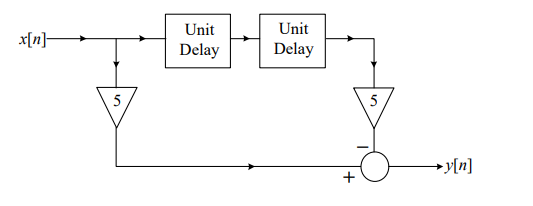
The filter can be used to approximate a


