
What does inclusive education entail?
Flexibility in the curriculum as a result of recognition of individual differences
Inclusive education means educating all children, including those with disabilities and those from disadvantaged groups, together in regular classrooms. The RTE Act 2009, the RPwD Act 2016 and NEP 2020 all ask schools to adapt to the learner rather than make the learner fit a rigid system.
Because every child differs in ability, pace, language and background, inclusion needs a flexible curriculum, adapted teaching methods and varied assessment, so that individual differences are recognised and catered for within the same classroom.
Giving learners with special needs only vocational education narrows their choices and is itself a form of exclusion. Segregating and categorising students by ability is the opposite of inclusion. One standard curriculum for all ignores individual differences and leaves many learners behind.
Flexibility in the curriculum as a result of recognition of individual differences option is correct.
Similar Questions
The value of the expression \((-3)^3 \times (0.3)^{-2} \times 0.01\) lies between which of the following ranges?
In a class test, a student earns 3 marks for every correct answer and loses 2 marks for every incorrect answer. No marks are given for questions left unattempted. If Radhika scored 20 marks and had 12 correct answers, how many questions did she attempt incorrectly?
If a polyhedron has 6 faces and 12 edges, what is the number of its vertices?
If \(a\) and \(b\) are positive integers (where \(b \neq 0\)) such that \(a^b = 1331\), then what is the value of \((a+b)^{a-b-8}\)?
Numbers that can be expressed as the sum of two cubes in two different ways are known as:
If \(x + \dfrac{y}{2} = \dfrac{1}{4}\), \(y + \dfrac{z}{2} = \dfrac{1}{4}\) and \(z + \dfrac{x}{2} = \dfrac{1}{4}\), then what is the value of \(x + y + z\)?
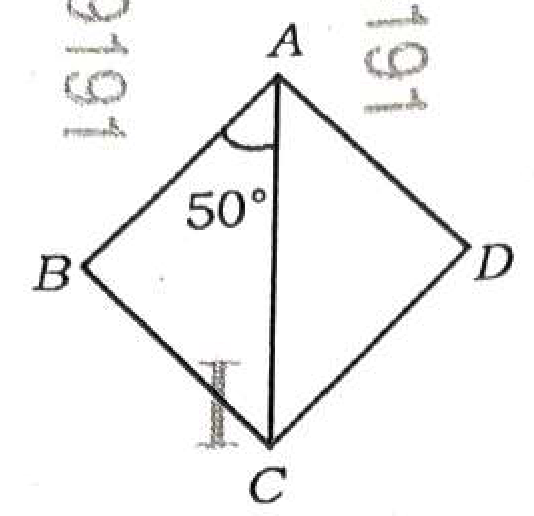
ABCD is a rhombus in which \(\angle BAC = 50^\circ\). What is the value of \(3\angle D - 2\angle DAC\)?
What is the value of \(\dfrac{\sqrt{450}}{\sqrt{338}} \div \dfrac{\sqrt{125}}{\sqrt{245}}\)?
The selling price of a toy is Rs. 1,020. If the profit made by the shopkeeper is 20%, what is the cost price of the toy?
The denominator of a rational number is greater than its numerator by 4. If 1 is added to both the numerator and the denominator, the resulting fraction is \(\dfrac{1}{2}\). Find the rational number.
Important Questions from Mixed Topic (JTET)
What type of process is thinking ?
The normal cause of origin of motivation is
How is impulse important for a teacher ?
The motive which forms due to social ideals, status, relations etc. is called
The learning in children starts from



