
V-I graph for a platinum wire at temperatures \( T_1 \) and \( T_2 \) is shown in the given figure. The temperature difference \( (T_2 - T_1) \) is proportional to: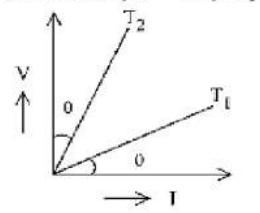
\( \cot 2\theta \)
The slope of the V-I graph is related to the resistance \( R \), which in turn depends on temperature. The temperature difference \( (T_2 - T_1) \) is proportional to \( \cot 2\theta \), as resistance increases with temperature following the relation:
\[ R = R_0 (1 + \alpha (T - T_0)) \]
where \( \alpha \) is the temperature coefficient of resistance. This leads to the dependence on \( \cot 2\theta \), making option 4 correct.
Important Questions from Current Electricity
Figure shows drift speed Vd of conduction electrons in a copper wire versus position (X) for the three sections. Then,
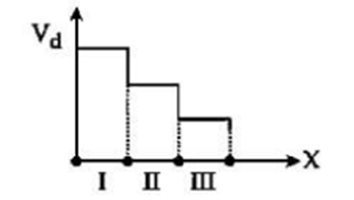
A. Radius of III > Radius of II > Radius of I
B. Electric Field in III > Electric Field in II > Electric Field in I
C. Radius of wire is same in all sections
D. Conductivity is same in all sections
Choose the correct answer from the options given below:
Which of the following circuits cannot be used to measure the resistance of resistor R?
The temperature at which the resistance of a conductor becomes 30% more than that of its resistance at 47°C will be:
(Given the value of the temperature coefficient of resistance of the conductor is 2 × 10⁻⁴ K-1.)
Cell having an emf E and internal resistance r is connected across a variable external resistance R. As the resistance R is increased, the plot of potential difference V across R is given by:
In the potentiometer circuit, the balance point is at X. The balance point will be shifted right towards B when:
A. Resistance R is increased keeping all other parameters constant
B. Resistance S is increased keeping all other parameters constant
C. Cell P is replaced by another cell whose emf is lower than Q
D. The polarity of Q is reversed
Choose the correct answer from the options given below:


