
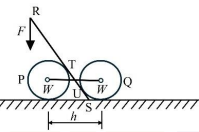
Two smooth drums each weighing $W$ and radius, $r$ are connected by a stiff rope of length, $h$ as shown in the figure. Force $F$ is applied using a massless lever (RS) of length, $l$. The friction between the drums and the lever (RS) is negligible. The system is in static equilibrium.
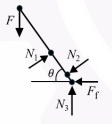
Which one of the following represents the CORRECT free body diagram of the lever (RS)?
Figures are not to scale. $N_1, N_2,$ and $N_3$ in the options are reaction forces and $F_f$ is the frictional force.
To determine the correct free body diagram (FBD) for the lever (RS) in the system, we need to consider the forces acting on it. The key forces involved are:
- \(N_1\), \(N_2\), and \(N_3\): Reaction forces exerted by the drums at points of contact on the lever.
- \(F_f\): Frictional force.
- Applied force \(F\) at point R.
Given that the friction between the drums and the lever is negligible, we can ignore \(F_f\) in our analysis.
The system is in static equilibrium, so the sum of forces and the sum of moments about any point must be zero. The forces exerted by the drums will be normal forces at the points where they contact the lever.
Let's consider the option with the following forces for the lever (RS): \(N_1\), \(N_2\), and \(F\). The correct FBD should show these forces with appropriate direction:
Analyzing the options:
- If \(F\) is the applied force, it should act downwards at point R, as shown in the correct diagram.
- \(N_1\) and \(N_2\) should be the normal reaction forces at the points where each drum contacts the lever.
The option identified shows the correct distribution of normal forces acting on the lever (RS) in equilibrium.
Important Questions from Vector Algebra
Vector A̅ = ŷ.3 + ẑ.2 and B̅ = x̂.5 + ŷ.8 extend from the origin. Find A̅.B̅ Choose the correct answer.
The value of the cross product \(\left( {\overrightarrow a - \overrightarrow b } \right) \times \left( {\overrightarrow a + \overrightarrow b } \right)\) of two vectors \(\overrightarrow a - \overrightarrow b\) and \(\overrightarrow a + \overrightarrow b \) is:
If non - zero a, b, c are such that a + b + c = 0, then the value of \(\frac{a^2}{bc} + \frac{b^2}{ac} + \frac{c^2}{ab}\) is
Vector a = 3i + 2j – 6k, vector b = 4i – 3j + k, angle between above vectors is
Two forces F1 and F2 are used to pull a car, which met an accident. The angle between the two force is θ. Find the value of θ for the resultant force is equal to \(\sqrt{(F_1^2 + F_2^2)}\)


