
Two fully penetrating wells are dug 1.4 km apart in a homogenous confined aquifer. The difference in their piezometric levels is 4.0 m. The groundwater flow is steady and unidirectional. If the aquifer has a hydraulic conductivity of $3.5\ m\cdot day^{-1}$ and effective porosity of 40%, the time taken for water to move from one well to the other in days is _____________. [in integer]
Calculate Groundwater Travel Time Between Wells
This solution calculates the time required for groundwater to travel between two wells in a confined aquifer, considering the given parameters like distance, piezometric difference, hydraulic conductivity, and effective porosity.
Groundwater Flow Velocity Calculation
The time of travel ($t$) is determined by the distance ($L$) and the average linear velocity (seepage velocity, $v_x$) of the groundwater. The formula is:
$ t = \frac{L}{v_x} $
The seepage velocity ($v_x$) is calculated using the hydraulic conductivity ($K$), the hydraulic gradient ($i$), and the effective porosity ($n_e$):
$ v_x = \frac{K \cdot i}{n_e} $
The hydraulic gradient ($i$) is the ratio of the difference in piezometric levels ($\Delta h$) to the distance between the wells ($L$):
$ i = \frac{\Delta h}{L} $
Combining these, the time of travel can be expressed as:
$ t = \frac{L \cdot n_e}{K \cdot i} = \frac{L^2 \cdot n_e}{K \cdot \Delta h} $
Step-by-Step Calculation
- Identify Given Parameters:
- Distance ($L$): $1.4\ km = 1400\ m$
- Piezometric head difference ($\Delta h$): $4.0\ m$
- Hydraulic conductivity ($K$): $3.5\ m\cdot day^{-1}$
- Effective porosity ($n_e$): $40\% = 0.40$
- Calculate Hydraulic Gradient ($i$):
$ i = \frac{\Delta h}{L} = \frac{4.0\ m}{1400\ m} = \frac{1}{350} $
- Calculate Seepage Velocity ($v_x$):
$ v_x = \frac{K \cdot i}{n_e} = \frac{(3.5\ m\cdot day^{-1}) \cdot (\frac{1}{350})}{0.40} = \frac{3.5}{140}\ m\cdot day^{-1} = 0.025\ m\cdot day^{-1} $
- Calculate Time of Travel ($t$):
$ t = \frac{L}{v_x} = \frac{1400\ m}{0.025\ m\cdot day^{-1}} = 56000\ days $
- Alternative Calculation using Combined Formula:
$ t = \frac{L^2 \cdot n_e}{K \cdot \Delta h} = \frac{(1400\ m)^2 \cdot 0.40}{(3.5\ m\cdot day^{-1}) \cdot (4.0\ m)} = \frac{1960000 \cdot 0.40}{14.0}\ days = \frac{784000}{14}\ days = 56000\ days $
Final Answer
The time taken for water to move from one well to the other is 56000 days.
Important Questions from Darcy Law
- A homogeneous isotropic confined aquifer of uniform thickness $30 \text{ m}$ has hydraulic conductivity of $5 \text{ m/day}$ and porosity of $0.3$. There are two observation wells X and Y along a radial line from a fully penetrating pumping well at $100 \text{ m}$ and $200 \text{ m}$ distance, respectively. The well is pumped at a uniform rate to produce steady drawdown of $5 \text{ m}$ at X and $3 \text{ m}$ at Y. If a non-reactive pollutant enters at the observation well Y, then the time taken by the pollutant (under advection) to reach the observation well X is ________ days. (rounded off to two decimal places)
- The kinematic viscosity of glycerin and kerosene are 1.2 times and 0.95 times of that of water, respectively. Glycerin and kerosene flow through two identical porous media having same hydraulic gradient. Assuming Darcy's law is valid for the porous media, the ratio of flow rate of kerosene to that of glycerin is
Two reservoirs having a difference of 20 m in their water surface elevations are connected through a confined aquifer (thickness = 5 m, length = 2 km, hydraulic conductivity $K = 3 \times 10^{-3}$ m/s, and porosity $\eta = 0.3$) as shown in the following figure (drawn not to scale).
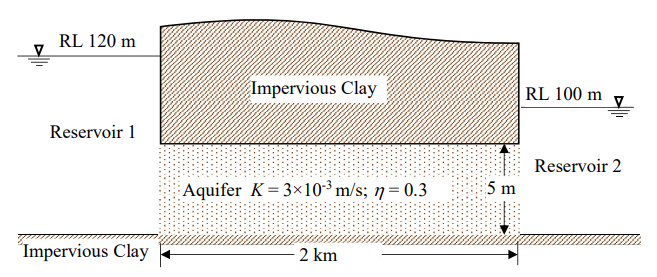
If the Reservoir 1 is contaminated by a pollutant then the time (in days, rounded off to one decimal place) taken by the pollutant to reach to the Reservoir 2 under advection will be ________- In a field test of a geological formation of permeable soil (porosity = 20%), the hydraulic gradient was found to be 2%. The actual seepage velocity of the flow was found to be 0.0025 m/s. Assume that the flow is in the laminar regime. The permeability (K) of the aquifer is ________ m/s (rounded off to three decimal places).


