
To determine the force in BD of the truss shown in the figure below, a section is passed through BD, CD and CE and the moments are taken about
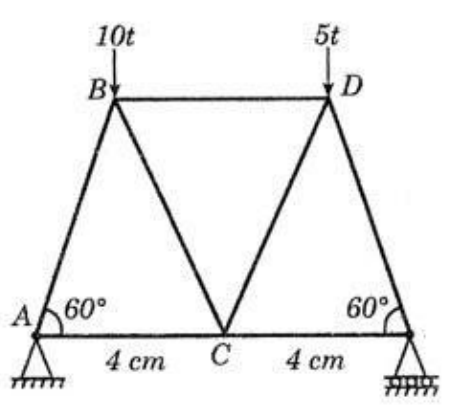
To determine the force in member BD of the truss, we apply the method of sections, which allows us to cut the truss through three members and consider the equilibrium of one of the resulting sections.
In this case, we pass a section through members BD, CD, and CE. To apply this method effectively, it is essential to take moments about a joint that is not intersected by the section. The best choice in this scenario is joint C because it is directly connected to the members cut by the section, and using it will eliminate the forces at other joints in the calculation.
Let's verify why joint C is the correct choice:
- Joint A: If we take moments around joint A, we would still have to deal with forces in members AC and AB, making the calculation complex.
- Joint B: Taking moments about joint B would include the forces in members BA and BC, both unaffected by the section.
- Joint C (Correct Choice): Taking moments about joint C simplifies calculations as the moments will directly relate to forces in BD, CD, and CE, hence directly solving for the interest member BD.
- Joint D: Similarly, joint D will involve unnecessary complexity due to interactions at the supports and other members.
Thus, taking moments about joint C allows us to focus on the internal forces in the members directly cut by the section, simplifying the analysis and solution for the force in BD.
By performing the equilibrium analysis about joint C, calculate as follows:
Summing moments about joint C:
M_C = 0 = (Force_{BD} \times \text{Perpendicular Distance}) - (Other Forces and Distances)This allows us to solve for the unknown force in BD directly.
Conclusion: The correct choice for simplifying the calculation of force in member BD via the section method is joint C.
Important Questions from Truss
Generally purlins are placed at the panel points so as to avoid :
If the member of a structure connected does NOT lie in the same plane, then the structure is called as-
Assertion (A): Trusses comprise triangular figures.
Reason (R): A pin-jointed stable figure is a triangle.
What is the function of portal in bridge trusses?
Which of the following statements is true?
A. Simple trusses consist entirely of a triangle.
B. It can consists of any other shaped intermediate parts, as long as it is stable.


