There are three rooms (I, II and III) with occupancy capacity of three each. P, Q, R, S and T are five friends. R and S occupied room I; T occupied room II. In how many different ways can P and Q occupy the rooms if there is no additional restriction?
8
Each room holds at most 3 people. Room I already has R and S (1 slot free), Room II has T (2 slots free), Room III is empty (3 slots free).
Place P first: it can go to Room I, II or III (3 choices), since all still have space.
If P → Room I (now full), Q can go to Room II or III: 2 choices.
If P → Room II (1 slot left there), Q can go to Room I, II or III: 3 choices.
If P → Room III (2 slots left there), Q can go to Room I, II or III: 3 choices.
Total ways = 2 + 3 + 3 = 8.
Similar Questions
A person has to make a payment of ₹56. He has twenty-five ₹2 coins and nine ₹5 coins. In how many different ways can he make this payment?
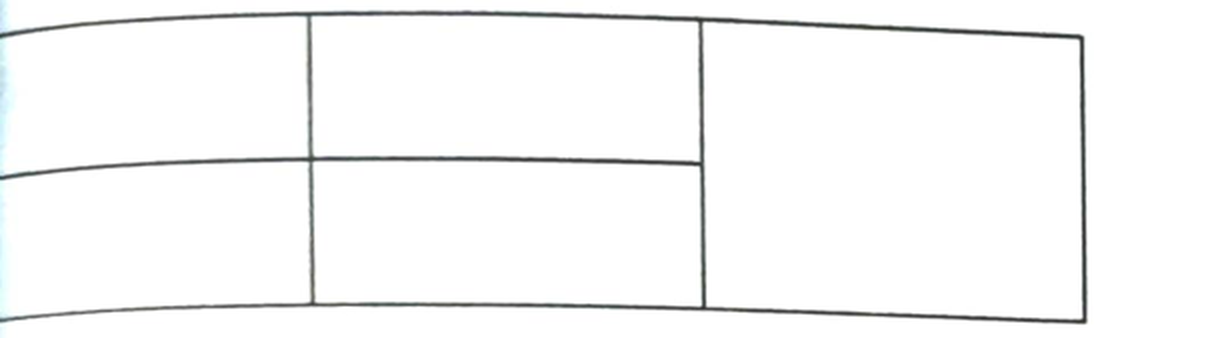
A rectangular wall is partitioned into 5 rectangular parts as shown in the following diagram. If you have three different colours to paint the wall and if no two adjacent parts are to be painted with the same colour, in how many different ways can one paint the wall?
In a matching problem, there are two columns. The first column has 4 statements whereas the second column has 5 statements. Every statement of the first column is to be matched with exactly one statement of the second column. In how many different ways can one student match the two columns if the student has no idea of the correct match?
Important Questions from Permutation and Combination
The following figure is made with nine squares of length 1 cm each.
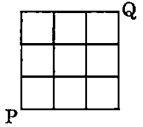
A student is standing at point P. The total number of shortest paths to reach point Q from point P, if the student walks along the boundaries of the squares only, is:
Consider the following statements (all the angles are measured in degrees) :
1. If two supplementary angles are $4x + 40$ and $10x$, then $x$ is;
2. The complementary angle of $\frac{4}{5} \times 45$ is :
3. If two complementary angles are in the ratio of $4 : 5$, then the smallest angle is :
Which of the following is correct?
Codes:
1 2 3- There are 40 persons in a palace. If every person shakes hands with every other person, what will be the total number of handshakes?
- How many words can be formed with or without meaning by using all letters of the word DELHI?
A rectangular wall is divided into four squares of equal size where there are two rows each having two squares. The top left square is coloured with green. If, including green, there are three colours available and each square is coloured using any one of these three colours such that no two adjacent squares get painted with the same colour; then how many colour combinations are possible ?