
The wavefunction of a particle in one dimension is given by
$\psi(x) = \begin{cases} M, & -a < x < a \\ 0, & \text{otherwise.} \end{cases}$
Here $M$ and $a$ are positive constants. If $\phi(p)$ is the corresponding momentum space wavefunction, which one of the following plots best represents $|\phi(p)|^2$ ?
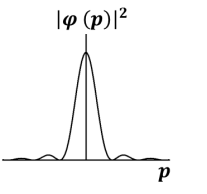
Momentum Wavefunction Calculation
The momentum space wavefunction $\phi(p)$ is obtained by taking the Fourier transform of the position space wavefunction $\psi(x)$. Given $\psi(x) = M$ for $-a < x < a$ and $0$ otherwise, the Fourier transform integral is:
$ \phi(p) = \frac{1}{\sqrt{2\pi\hbar}} \int_{-a}^{a} M e^{-ipx/\hbar} dx $
Evaluating this integral yields:
$ \phi(p) = \frac{M}{\sqrt{2\pi\hbar}} \left[ \frac{e^{-ipx/\hbar}}{-ip/\hbar} \right]_{-a}^{a} $
$ \phi(p) = \frac{M\hbar}{-ip\sqrt{2\pi\hbar}} \left( e^{-ipa/\hbar} - e^{ipa/\hbar} \right) $
Using the trigonometric identity $e^{i\theta} - e^{-i\theta} = 2i \sin(\theta)$, which implies $e^{-i\theta} - e^{i\theta} = -2i \sin(\theta)$, we simplify $\phi(p)$:
$ \phi(p) = \frac{M\hbar}{-ip\sqrt{2\pi\hbar}} \left( -2i \sin(pa/\hbar) \right) = \frac{2M\hbar}{p\sqrt{2\pi\hbar}} \sin(pa/\hbar) $
$ \phi(p) = \sqrt{\frac{2\hbar}{\pi}} M \frac{\sin(pa/\hbar)}{p} $
Analyzing the Shape of $|\phi(p)|^2$
The probability density in momentum space is $|\phi(p)|^2$. We can express $\phi(p)$ in terms of the sinc function. Let $y = pa/\hbar$. Then $p = y\hbar/a$. Substituting this:
$ \phi(p) = \sqrt{\frac{2\hbar}{\pi}} M \frac{\sin(y)}{y\hbar/a} = \sqrt{\frac{2\hbar}{\pi}} M \frac{a}{\hbar} \frac{\sin(y)}{y} $
$ \phi(p) = \left( \sqrt{\frac{2a^2}{\pi\hbar}} M \right) \frac{\sin(pa/\hbar)}{pa/\hbar} $
Thus, $|\phi(p)|^2$ is proportional to the square of the sinc function:
$ |\phi(p)|^2 \propto \left( \frac{\sin(pa/\hbar)}{pa/\hbar} \right)^2 $
This function, the squared sinc function, has specific characteristics:
- It has a maximum value at $p=0$.
- It is symmetric with respect to the p-axis ($p=0$).
- It passes through zero when $pa/\hbar = n\pi$ for non-zero integers $n$, i.e., at $p = \pm \frac{n\pi\hbar}{a}$.
- It decays towards zero as $|p|$ becomes large ($|p| \to \infty$).
Matching the Plot
We need to find the plot that matches these characteristics. Examining the options:
- Options 1 and 2 start at $|\phi(p)|^2 = 0$ at $p=0$. This is incorrect; the function peaks at $p=0$.
- Option 4 shows a peak that is not centered at $p=0$ and does not decay symmetrically to zero in the expected manner.
- Option 3 displays a function with a clear maximum at $p=0$, symmetrical decay, zeros at specific intervals, and decay to zero at large $|p|$. This aligns perfectly with the properties of $|\phi(p)|^2 \propto \text{sinc}^2(pa/\hbar)$.
Therefore, the plot in Option 3 is the correct representation.
Important Questions from Operators Commutators Heisenberg Picture
- Consider an operator $\hat{A}$ which is not Hermitian. Find the possible values of $c$ and $d$ such that the operator $(c\hat{A} - d\hat{A}^\dagger)$ is Hermitian.
- Which of the following operators is/are self-adjoint?
- Consider operators $\hat{A}$, $\hat{B}$, and $\hat{C}$ for three observables of a quantum system satisfying $[\hat{A}, \hat{B}] = 0$, $[\hat{B}, \hat{C}] = 0$, and $[\hat{A}, \hat{C}] \neq 0$, with uncertainties $\Delta A, \Delta B, \Delta C$, respectively. From the options given below, which is/are implied by the commutation relations among $\hat{A}, \hat{B}$, and $\hat{C}$?
- Let $|m\rangle$ and $|n\rangle$ denote the energy eigenstates of a one-dimensional simple harmonic oscillator. The position and momentum operators are $\hat{X}$ and $\hat{P}$, respectively. The matrix element $\langle m|\hat{P}\hat{X}|n\rangle$ is non-zero when
- If $H$ is the Hamiltonian for a free particle with mass $m$, the commutator $[x, [x, H]]$ is


