
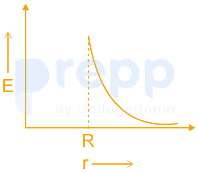
The variation of electric field with respect to distance from centre of a charged conducting spherical shell of radius R is given by :
Understanding Electric Field of a Charged Conducting Spherical Shell
This question asks about how the electric field changes as we move away from the center of a charged conducting spherical shell. A conducting spherical shell is a sphere made of a conductive material that is hollow inside.
Key Properties of Conductors in Electrostatics
For a conductor in electrostatic equilibrium (when charges are not moving):
- The net electric field inside the body of the conductor is zero.
- Any net charge resides entirely on the surface of the conductor.
- The electric potential is constant throughout the volume of the conductor.
These properties are crucial for understanding the electric field distribution around a charged conducting spherical shell.
Electric Field Calculation for a Charged Conducting Spherical Shell
We can calculate the electric field at different distances from the center using Gauss's Law or by considering the charge distribution.
Case 1: Inside the Shell (r < R)
Consider a spherical Gaussian surface with radius $r < R$ inside the conducting shell. Since the shell is a conductor and is in electrostatic equilibrium, any net charge resides only on the outer surface. Therefore, the total charge enclosed by the Gaussian surface is zero.
According to Gauss's Law, the total electric flux through a closed surface is proportional to the enclosed charge:
\(\oint \vec{E} \cdot d\vec{A} = \frac{Q_{enclosed}}{\epsilon_0}\)
Here, \(Q_{enclosed} = 0\). Thus, the electric flux is zero.
\(E \cdot 4\pi r^2 = \frac{0}{\epsilon_0}\)
\(E = 0\)
So, the electric field inside a charged conducting spherical shell is zero everywhere.
Case 2: On the Surface of the Shell (r = R)
At the surface of the conductor, the electric field is non-zero and points perpendicular to the surface. If the total charge on the shell is Q, distributed uniformly on the outer surface, the electric field right at the surface (outside) can be found. It is given by:
\(E_{surface} = \frac{1}{4\pi\epsilon_0} \frac{Q}{R^2}\)
This represents the maximum value of the electric field at any distance from the center for \(r \ge R\).
Case 3: Outside the Shell (r > R)
Consider a spherical Gaussian surface with radius $r > R$ outside the shell. The entire charge Q on the shell is enclosed by this Gaussian surface. Due to spherical symmetry, the electric field is radial and has the same magnitude at all points on the Gaussian surface.
Using Gauss's Law:
\(\oint \vec{E} \cdot d\vec{A} = \frac{Q_{enclosed}}{\epsilon_0}\)
\(E \cdot 4\pi r^2 = \frac{Q}{\epsilon_0}\)
\(E = \frac{1}{4\pi\epsilon_0} \frac{Q}{r^2}\)
This means that for points outside the shell, the electric field decreases with the square of the distance from the center, just like the field of a point charge Q located at the center of the shell.
Variation of Electric Field with Distance (r)
Summarizing the results:
- For \(r < R\), \(E = 0\)
- For \(r = R\), \(E = \frac{1}{4\pi\epsilon_0} \frac{Q}{R^2}\) (maximum value for \(r \ge R\))
- For \(r > R\), \(E = \frac{1}{4\pi\epsilon_0} \frac{Q}{r^2}\)
Let's describe the graph of E versus r:
- Starting from the center (\(r=0\)) up to the radius of the shell (\(r=R\)), the electric field is zero. The graph should be a horizontal line on the r-axis.
- Exactly at the surface (\(r=R\)), the electric field abruptly increases to its maximum value \( \frac{1}{4\pi\epsilon_0} \frac{Q}{R^2} \). There should be a discontinuity or a sudden jump in the graph at \(r=R\).
- For distances greater than the radius (\(r > R\)), the electric field starts decreasing from its maximum value at \(r=R\). The dependence is \( E \propto \frac{1}{r^2} \), which means the graph should show a curve that decreases as the distance increases, approaching zero as \(r \to \infty\).
Looking at the provided graphical options (represented by image IDs), we need to identify the graph that matches this description: zero field inside, a jump at the boundary, and then a $1/r^2$ decay outside. The graph represented by data-src-id="66151ad26c11d964bb830d8c" visually depicts this behavior correctly.
Revision Table: Electric Field of Charged Spherical Shell
| Region | Distance (r) | Electric Field (E) | Behavior |
|---|---|---|---|
| Inside the shell | \(0 \le r < R\) | \(E = 0\) | Zero |
| On the surface | \(r = R\) | \(E = \frac{1}{4\pi\epsilon_0} \frac{Q}{R^2}\) | Maximum (for \(r \ge R\)) |
| Outside the shell | \(r > R\) | \(E = \frac{1}{4\pi\epsilon_0} \frac{Q}{r^2}\) | Decreases as \(1/r^2\) |
Additional Information: Conducting vs. Non-Conducting Shells
It is important to distinguish this case from a non-conducting spherical shell or a solid sphere (conducting or non-conducting).
- Non-conducting spherical shell (uniform surface charge): The field outside is the same (\(1/r^2\) decay), but the field inside (r < R) is also zero, just like the conducting case. The graph E vs r would look the same.
- Non-conducting solid sphere (uniform volume charge): The field inside (r < R) is \( E = \frac{1}{4\pi\epsilon_0} \frac{Qr}{R^3} \), meaning it increases linearly with r from the center. The field outside (r > R) is still \( E = \frac{1}{4\pi\epsilon_0} \frac{Q}{r^2} \). The graph would show E increasing linearly from 0 at r=0 to a maximum at r=R, then decreasing as \(1/r^2\) for r > R.
- Conducting solid sphere: Since it's a conductor, all charge resides on the surface. The field inside (r < R) is zero, and the field outside (r > R) is \( E = \frac{1}{4\pi\epsilon_0} \frac{Q}{r^2} \). The graph E vs r looks exactly the same as for a charged conducting spherical shell.
Understanding the distinction between conducting and non-conducting materials, as well as volume vs. surface charge distributions, is key to solving problems involving electric fields of symmetric charge distributions.
Important Questions from Applications of Gauss’s Law
According to Gauss’s law, the electric field due to an infinitely long thin charged wire varies as:
An infinitly long wire is charged uniformly with charge density λ and placed in air, the electric field at distance r from wire will be:
- An infinitely long straight uniformly charged wire has a linear charge density of $\lambda$. Calculate the work done by the electric field when a point charge $q$ is moved from an initial distance $r_1$ to a final distance $r_2$ ($r_2 > r_1$) from the wire.
Find the electric field outside the cylinder, a distance r from the axis using Gauss's law, if a long & straight wire is surrounded by a hollow metal cylinder whose axis coincides with that of the wire. The wire has a charge per unit length of λ, and the cylinder has a net charge per unit length of 2λ?
An isotropic radiation has a field pattern given by $E=\frac{10I}{r} v/m$ where I is the terminal current and r is the distance in meters. The radiation resistance of the antenna is ____________.


