The value of initial tension in belts is equal to
Average tension of the tight side and slack side of the belt
Understanding Initial Tension in Belts
When a belt drive system is not running, the belt is installed with a certain amount of tension. This tension is present throughout the belt and is called the initial tension or static tension ($T_0$). This initial tension is crucial because it allows the belt to transmit power when the system starts operating.
Belt Tension During Operation
Once the belt drive is running and transmitting power, the tension in the belt changes. The side of the belt moving towards the driving pulley becomes tighter, known as the tight side, and has a tension denoted as $T_1$. The side of the belt moving away from the driving pulley becomes slacker, known as the slack side, and has a tension denoted as $T_2$. Power is transmitted due to the difference in tension between the tight side and the slack side ($T_1 - T_2$).
Relating Initial Tension to Operating Tensions
The initial tension ($T_0$) is the tension in the belt when it is stationary. When the system starts running, the belt stretches on the tight side and contracts on the slack side, while the total length of the belt remains essentially constant. Assuming the belt material follows Hooke's Law and the total elongation and contraction balance out, the initial tension ($T_0$) is the average of the tensions on the tight side ($T_1$) and the slack side ($T_2$) during operation. This ensures that the total force on the pulleys remains constant, whether the belt is stationary with tension $T_0$ or running with tensions $T_1$ and $T_2$.
Mathematically, the initial tension $T_0$ is given by the formula:
\(T_0 = \frac{T_1 + T_2}{2}\)
where:
- \(T_0\) is the initial tension
- \(T_1\) is the tension in the tight side of the belt
- \(T_2\) is the tension in the slack side of the belt
Analyzing the Options
Let's look at the given options in relation to the definition and formula of initial tension:
- Option 1: Tension in the tight side of the belt ($T_1$). This is the tension when the belt is operating under load, not the initial tension when it is stationary.
- Option 2: Tension in the slack side of the belt ($T_2$). This is also the tension when the belt is operating under load, not the initial tension.
- Option 3: Sum of the tension in the tight side and slack side of the belt ($T_1 + T_2$). This is twice the initial tension, not the initial tension itself.
- Option 4: Average tension of the tight side and slack side of the belt (\(\frac{T_1 + T_2}{2}\)). This matches the formula for initial tension derived from the balance of forces when the belt transitions from a stationary state to an operating state.
Therefore, the value of initial tension in belts is equal to the average tension of the tight side and slack side of the belt.
Important Questions from Belt Tension
A belt drives a pulley of 200 mm diameter such that the ratio of tensions in the tight side and the slack side is 1.2, the maximum tension in the belt is not to exceed 240 kN. The speed of pulley is 60 rpm. Find the safe power transmitted by the pulley.
The tight and slack sides of a belt connecting two pulleys are having tensions of 25 N and 15 N respectively, while the belt is running at 10 m/s. The power transmitted as
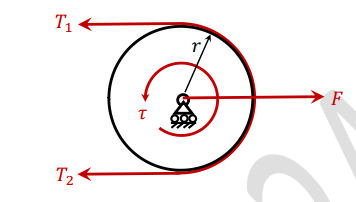
A flat belt drive with pulley of $r = 20$ cm radius is designed to transmit 6.283 kW power at 600 RPM. In the figure, $\tau$ is the corresponding torque. If the coefficient of static friction between the belt and the pulley is 0.3, then the minimum value of the tightening force $F$ (in kN) required to prevent the belt slip is ________.(Rounded off to 2 decimal places)