
The typical dB magnitude versus characteristics of the compensators is given below :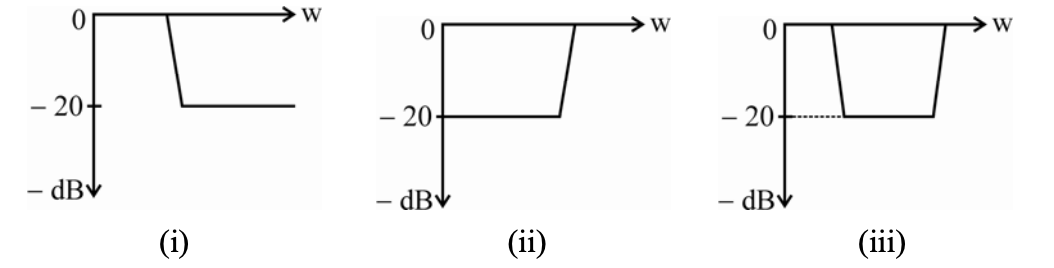
(a) (i) is log compensator and (ii) is lead compensator
(b) (ii) is lead compensator and (i) is log compensator
(c) (ii) is lead compensator and (iii) is log compensator
(d) (i) is log compensator and (ii) is log-lead compensator
Which of the above are correct ?
To determine the correct pairing of compensators with their typical dB magnitude versus frequency characteristics, let's first understand the characteristics of lead and lag compensators:
- Lead Compensator: A lead compensator enhances the high-frequency gain and provides a positive phase angle. Its Bode magnitude plot typically starts flat, increases to a peak, and then flattens at a higher magnitude level.
- Lag Compensator: A lag compensator decreases the high-frequency gain and provides a negative phase angle. Its Bode magnitude plot generally starts flat, declines to a lower level, and then flattens at a lower level.
Now, let's analyze the images:
- Image (i): This plot starts at 0 dB, decreases, and then flattens. This behavior matches the typical characteristic of a lag compensator.
- Image (ii): This plot starts at 0 dB, increases, and then flattens at a higher level. This behavior matches the typical characteristic of a lead compensator.
- Image (iii): This appears to be another representation of a lag compensator. It starts at 0 dB, decreases more prominently, and flattens at a lower level.
Based on the analysis, the pairings are as follows:
- (ii) is a lead compensator.
- (iii) is a lag compensator.
Thus, the correct answer is:
(b) and (c)
Important Questions from Controllers and Compensators
Given below are two statements:
Statement I: In proportional control, the actuating signal for the control action in a control system is proportional to the error signal
Statement II: It is desirable that control system be over damped for the point of view of quick response
In the light of the above statements, choose thecorrectanswer from the options given below:
Which of the following controllers improves the transient response of a system?
The transfer function of the lead compensator is:
The overall transfer function of a control system is given by the following equation. Find out the value of Derivative rate feedback constant K t. (Consider the Damping ratio 0.9)
\(\dfrac{C(s)}{R(s)}= \dfrac{36}{s^2+3.6s+36}\)
The transfer function \(\frac{{1 + 0.5s}}{{1 + s}}\) represent a


