
The transformation of time in, modern society in the form of 'timelessness' was emphasized by which scholar?
Understanding Time Transformation in Modern Society
The question asks about the scholar who significantly emphasized the transformation of time in modern society, specifically using the concept of 'timelessness'. This concept is crucial for understanding how our experience and organization of time are changing in the contemporary world.
Identifying the Scholar of 'Timelessness'
Among the prominent scholars listed, Manuel Castells is most famously associated with the concept of 'timeless time' as a key characteristic of the information age and the network society. In his seminal work, "The Information Age: Economy, Society, and Culture," Castells analyzes how new technologies and social structures reshape fundamental dimensions like time and space.
Manuel Castells and 'Timeless Time'
Manuel Castells argues that in the network society, a new form of temporality emerges which he calls 'timeless time'. This is not the absence of time, but a disruption of linear, chronological time. Time becomes disordered, reversible, or asynchronous for specific activities and individuals, organized around the logic of flows rather than fixed points or cycles.
- It is driven by the logic of capital accumulation, technological innovation, and media culture.
- It allows for instantaneity, simultaneity, and the blurring of past, present, and future.
- Examples include global financial markets operating 24/7, instant global communication, and flexible work schedules.
This concept contrasts with traditional notions of time, such as cyclical time (common in agrarian societies) or linear, clock-time (characteristic of industrial capitalism).
Comparing with Other Scholars
While other scholars mentioned also discussed time and space transformations, their primary concepts differ:
- Marshall McLuhan: Known for his work on media and communication, particularly concepts like the 'global village' and "the medium is the message." He discussed how media alters our perception of time and space but didn't centralize the concept of 'timelessness' in the same way Castells did.
- David Harvey: A key figure in critical geography and Marxist theory. He developed the concept of 'time-space compression', explaining how the acceleration of capital circulation and technological advancements shrink time and space, making the world feel smaller and faster. This is related to Castells' ideas but focuses more on the intensity and compression rather than the breakdown of linearity into 'timelessness'.
- Anthony Giddens: Known for his work on structuration theory and late modernity. He discussed the separation of time and space ('disembedding') and the influence of abstract systems in modern life. While his work touches upon the transformation of time, 'timelessness' is not his central concept in describing this change.
Therefore, the concept of 'timelessness' or 'timeless time' is most strongly associated with the work of Manuel Castells.
Revision Table: Scholars and Concepts
| Scholar | Key Concept(s) Related to Time/Space |
|---|---|
| Marshall McLuhan | Global Village, Media effects on time/space perception |
| David Harvey | Time-Space Compression |
| Manuel Castells | Timeless Time, Space of Flows, Network Society |
| Anthony Giddens | Disembedding of time and space, Reflexive Modernity |
Additional Information: Manuel Castells' Framework
Manuel Castells' analysis of 'timeless time' is part of a larger framework describing the 'network society'. In this society, social structures are organized around electronically processed information networks. This structural transformation profoundly impacts various aspects of life, including the economy (global informational economy), culture (real virtuality), and social movements.
The concept of 'timeless time' is paired with his concept of the 'space of flows'. The space of flows refers to the material arrangements that allow for simultaneity of social practices without territorial contiguity. This contrasts with the 'space of places', which is the traditional organization of space around specific locations. Both concepts highlight how the fundamental dimensions of social life are reorganized in the digital age, moving away from fixed, linear structures towards fluid, network-based organizations.
Understanding 'timeless time' helps explain phenomena such as the speed of financial transactions, the nature of global communication, and the challenges to traditional institutions based on linear time and fixed geography.
Important Questions from Miscellaneous
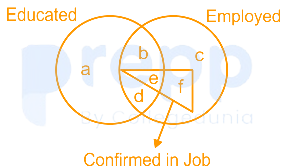
Read the given figure and find the region representing persons who are educated and employed but not confirmed in job.
The magazine in which Mahatma Gandhi mentioned what he wanted the Constitution to do is:
Which gas shields the surface of the earth from ultraviolet radiation from the sun?
Which event is marked as an Intangible Cultural Heritage of Humanity by UNESCO?
Who has been conferred with the rank of the Commander of the Order of the British Empire in 2018?


