
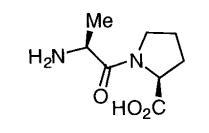
Dipeptide Ala-Pro Structure Identification
The question asks to identify the structure of the dipeptide Ala-Pro, formed from the amino acids Alanine (Ala) and Proline (Pro).
Understanding Dipeptide Formation
- A dipeptide is formed when two amino acids join via a peptide bond.
- The peptide bond links the carboxyl group ($-COOH$) of the first amino acid to the amino group ($-NH2$) of the second amino acid, releasing a molecule of water ($H2O$).
- In the dipeptide Ala-Pro, Alanine is the N-terminal amino acid and Proline is the C-terminal amino acid.
- Alanine has a side chain of a methyl group ($-CH3$).
- Proline has a unique cyclic structure where its side chain connects back to the nitrogen atom of the amino group, forming a pyrrolidine ring.
Analyzing Structures
The structure of Ala-Pro should show:
- The N-terminus derived from Alanine's amino group.
- The Alanine alpha-carbon with its methyl side chain.
- The peptide bond ($-CO-N-$) formed between Alanine's carboxyl group and Proline's amino group.
- The Proline ring structure attached to the peptide bond nitrogen.
- The C-terminus derived from Proline's carboxyl group.
By examining the provided options, Option 1 correctly depicts this structure:
This structure accurately represents the sequence and bonding characteristic of the Ala-Pro dipeptide derived from Alanine and Proline.
Important Questions from Peptides
- Chymotrypsin selectively cleaves a peptide at the carboxyl side of the amino acids having an aryl sidechain. The tripeptide(s) formed on hydrolysis of the peptide, Val-Phe-Leu-Met-Tyr-Pro-Gly-Trp-Cys, with chymotrypsin is(are)
A tetrapeptide, made up of natural amino acids, has alanine as the N-terminal residue which is coupled to a chiral amino acid. Upon complete hydrolysis, the tetrapeptide gives glycine, alanine, phenylalanine and leucine. The number of possible sequences of the tetrapeptide is ____________
- The tetrapeptide, Ala-Val-Phe-Met, on reaction with Sanger's reagent, followed by hydrolysis gives
Partial hydrolysis of a pentapeptide yields all possible tripeptides and dipeptides. The dipeptides that are obtained upon hydrolysis are given below.
Val-Ala, Gln-His, Phe-Val and Ala-GlnThe total number of tripeptides obtained that contain 'Ala' as one of the amino acids is ________ (in integer).


