
The side of a regular hexagon is 10 mm. What is the across flat to the flat of the hexagon?
17.32
The question asks us to find the distance across the flats of a regular hexagon when the length of its side is given as 10 mm.
Understanding Regular Hexagon Properties
A regular hexagon is a polygon with six equal sides and six equal interior angles. The distance 'across flats' refers to the shortest distance between two opposite parallel sides of the hexagon. This distance passes through the center of the hexagon.
Calculating the Distance Across Flats
To find the distance across flats, we can use a specific formula related to the side length ($s$) of the regular hexagon. A regular hexagon can be divided into six equilateral triangles, with each side of the triangle equal to the side length of the hexagon.
The distance from the center of the hexagon to the midpoint of a side is called the apothem ($a$). The apothem is the height of one of these equilateral triangles.
The formula for the apothem ($a$) of an equilateral triangle (and thus the apothem of the hexagon) with side length $s$ is:
$$a = \frac{s \sqrt{3}}{2}$$
The distance across flats is twice the apothem:
Distance across flats $= 2 \times a = 2 \times \left( \frac{s \sqrt{3}}{2} \right) = s \sqrt{3}$$
Step-by-Step Calculation
- Identify the given information: The side length ($s$) of the regular hexagon is 10 mm.
- Use the formula: The formula for the distance across flats is $s \sqrt{3}$.
- Substitute the side length: Substitute $s = 10$ mm into the formula. $$ \text{Distance across flats} = 10 \times \sqrt{3} $$
- Calculate the value: The approximate value of $\sqrt{3}$ is 1.732. $$ \text{Distance across flats} \approx 10 \times 1.732 $$
- Final Result: $$ \text{Distance across flats} \approx 17.32 \text{ mm} $$
Conclusion
Comparing the calculated distance with the given options, the value 17.32 mm matches option 1. Therefore, the distance across the flats of the regular hexagon is approximately 17.32 mm.
Important Questions from Miscellaneous
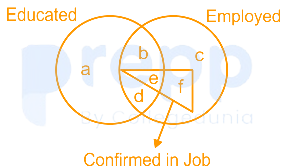
Read the given figure and find the region representing persons who are educated and employed but not confirmed in job.
The magazine in which Mahatma Gandhi mentioned what he wanted the Constitution to do is:
Which gas shields the surface of the earth from ultraviolet radiation from the sun?
Which event is marked as an Intangible Cultural Heritage of Humanity by UNESCO?
Who has been conferred with the rank of the Commander of the Order of the British Empire in 2018?


