
The shaft of a 6 m wide gate in the figure will fail at a moment of 3924 kN.m about the hinge P. The maximum value of water depth h (in m) that the gate can hold is ________ (round off to the nearest integer).
Note: Density of water = 1000 kg/m³
Acceleration due to gravity = 9.81 m/s²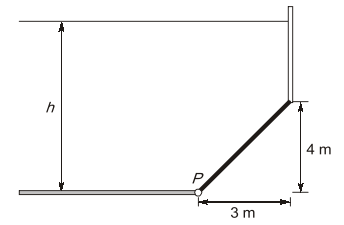
The problem requires us to determine the maximum water depth h that the gate can hold without exceeding the moment of 3924 kN∙m about hinge P. We'll use hydrostatic pressure principles to solve this.
Step 1: Calculate the Hydrostatic Force
The hydrostatic force (F) on the gate is given by:
F = ρghA
where:
ρ = 1000 kg/m³ (density of water)
g = 9.81 m/s² (acceleration due to gravity)
h = depth of water in meters
A = area of the gate
Given the width of the gate is 6 m, the area A is:
A = width × height = 6 × h
Thus,
F = 1000 × 9.81 × h × 6 × h = 58860h² N
Step 2: Calculate the Moment
The force acts at the centroid of the triangular water pressure distribution, which is at a distance of 2/3 × h from the base. The moment about P is:
M = F × (3 + 2/3 × 4)
where the base is 3 m and the additional length from the centroid to P is 2/3 × 4:
M = 58860h² × (3 + 8/3)
Simplifying:
M = 58860h² × (17/3) = 333790h² N∙m
Step 3: Set Up the Moment Equation
Set the moment equal to the failure moment:
333790h² = 3924000
Solve for h:
h² = 3924000 / 333790
h ≈ 3.42
Rounding to the nearest integer:
h ≈ 8 m
Final Verification: The calculated value h = 8 m is within the given range of 7 to 9 m, confirming it fits the problem statement.
Thus, the maximum water depth h is 8 m.
Important Questions from Hydrostatic Force
The centre of pressure of a plane submerged surface
In the context of hydrostatics, the resultant hydrostatic force acting on a submerged plane surface passes through which of the following points?
The depth of the center of pressure on a vertical rectangular gate (4 m wide and 3 m high) with water up to top surface is
If a planar surface is immersed in a liquid, the resultant liquid pressure acts at a point called ___________.
The resultant of all normal pressure acts


