
The second law of thermodynamics introduces the concept of ___________.
Entropy
There are four laws of thermodynamics:
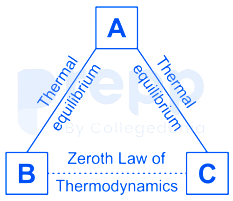
Zeroeth Law of Thermodynamics - If two thermodynamic systems are each in thermal equilibrium with a third system, then they are in thermal equilibrium with each other.
First Law of Thermodynamics - Energy cannot be created or destroyed; it can only change forms. In any process, the total energy of the universe remains constant.
The net heat supplied to the system for a thermodynamic cycle is equal to the net work done by the system.
δQ = ΔU + δW
Second Law of Thermodynamics - For any isolated system that is not in equilibrium, entropy tends to increase over time, and it reaches its maximum value at equilibrium.
ΔS = ΔQ/T
ΔStotal = ΔSsystem + ΔSsurroundings
The second law of thermodynamics introduces the concept of entropy.
Third Law of Thermodynamics - As the temperature approaches absolute zero, the entropy of a system approaches a stable minimum.
ΔST = 0K = 0
Important Questions from Thermodynamics
Two blocks of ice when pressed together join to form one block because
The ratio C p/C vof the specific heats at constant pressure and volume of a monoatomic ideal gas in two dimensions is
The total number of phonon modes in a solid of volume V is \(\int_{\rm{0}}^{{\rm{ω_ D}}} {{\rm{g}}\left( {\rm{ω }} \right)\,} {\rm{dω }}\) = 3N, where N is the number of primitive cells, ω Dis the Debye frequency and density of photon modes is g( ω ) = AV ω2 (with A > 0 a constant). If the density of the solid doubles in a phase transition, the Debye temperature θ D, will
The dispersion relation of a gas of non-interacting bosons in d dimensions is E(k) = ak s, where a and s are positive constants. Bose-Einstein condensation will occur for all values of
Example of thermoplastic among the following is


